Posted in Matilda's, Memoir Writing, Narrative Therapy, Women's Health, Women's Stories

Rosemary Batty – The Tower

The image of the Tower card is powerful, depicting a solid tower being struck by lightning, and fire crawling out from the small windows at its top.

As Death shows us, change can be hard. With the Tower, it can be brutal. Rosie Batty has written about her heartbreak.

“The Tower – whatever it represents in your reading – comes crashing to the ground. All that you held to be true is suddenly…not true. The world looks different, and it can feel like a disaster. This card’s usual image of lightening destroying a tower is incredibly scary – destruction is all that we can see. The ground is unsteady beneath our feet. We don’t know what to hold on to.”

There is no doubt that Rosie Batty’s world came crashing to the ground when her 11-year-old son Luke was killed by his father, Greg Anderson, at an oval in Tyabb, south-east of Melbourne, in February 2014. Sadly, at this point in time, Batty joined a club that no-one wants to be a member of. Members of this horrific club include Hannah Clarke’s parents, Darcy Freeman’s mum — the little girl that got thrown off the West Gate Bridge; and the Farquharson boys’ mother — whose three boys were drowned by their father in the lake.

Quite rightly Batty still wonders “How on Earth, when you become one of these tragedies — these worse-case scenario tragedies — how do you live with murder?”

“If anything comes out of this, I want it to be a lesson to everybody that family violence happens to everybody no matter how nice your house is, no matter how intelligent you are. It happens to anyone and everyone.”The Batty Effect

Many tarot readers talk about their own ‘Tower moments’, referring to those huge and very challenging moments in our lives where everything shifted. Most recall the terror at the moment of fallout but also observe that when the dust has settled things do regain some balance. There is no doubt that Batty’s work to raise awareness about family violence since Luke’s death, gave her “new distractions, new purpose”. Whether she will ever get over what happened is debatable. However, the impact of her work has been far reaching and provides some comfort for her.

By January 2016, she had spoken at approximately 250 events and addressed more than 70,000 people. She had also inspired Victorian Premier Daniel Andrews to commit to an Australian-first Royal Commission into Family Violence. She has, quite literally, changed the conversation about domestic violence in Australia.

Rebuilding

When you are ready, the Tower is also about those steps you take to rebuild.
Posted in Matilda's, Memoir Writing, Women's Health, Women's Stories

The Tower – Rose Jackson

Being outed, quitting your job, getting fired, getting dumped. Getting totally called out (and being able to learn from it). These are all examples of Tower moments. Shock events that feel incredibly painful, but that ultimately move us forwards, to a point of no return.

In this Pro Talk by Rachel Pollack, for the Arts University of Plymouth, Pollack provides rich insight into how liberating the destruction of the tower can be for transgender people who finally come out and claim their true identity.

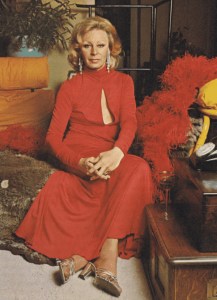
Perhaps best known as the star performer at Capriccios, the first gay club to open in Oxford St, Sydney, in the early 1970s, Rose Jackson’s career as both a costumier and entertainer boasted many highlights.

Born Barry Jackson on September 11 1935 at Paddington Women’s Hospital, Rose said she knew “from the minute she was born” that a male body was not right for her. An athletic young man, Barry loved to swim and for a short period was even a Bondi lifesaver. But it was ‘too butch’. Instead, gay men introduced Barry to a secret Sydney world of parties, fine dining and fashion; and when he began going out in public as a woman. He took the name Rose, after Marilyn Monroe’s character in Niagara, Rose Loomis.

The thing that has always distressed me – and it has taken me years and years to get over it – is the fact that one does have to lie. … It came to the point where I had to say: ‘This is the way I want to be’. But not without thirty years of the most dreadful traumatic pressure. When you consider that you have to live a lie for your parents, to the public, to your friends and your work, the problem seems insurmountable. It takes a long, long time to be able to say: ‘I don’t care about the rest of the world: this is my life and I cannot cheat myself by not living it’. All those things need to said. It takes great strength.
From a monologue by Rose Jackson

By the age of 18, Barry was working as a window dresser at David Jones. His design talent was noticed and he soon accepted a position as display manager for Curzons, where he coordinated around 300 fashion parades as well as designing and supervising the seasonal window displays. At 24, Barry went to Europe and, after time in London and Paris, worked as a display manager for a leading chain of department stores in Sweden.

By the time Barry returned to Sydney five years later, in 1964, his home city had changed. Walking home one night to his apartment in Kings Cross, he discovered a club called the Jewel Box, where not only were there drag performances but some of the boys were taking hormone therapy.

By the late 1960s, Barry was living fully as a woman in Paddington. Making costumes for Sydney’s leading theatre company, the Old Tote, by day, he performed at the Purple Onion club at night. It is the Purple Onion — on the site of the current Kens at Kensington — that can claim to have pushed Rose’s costume design skills to the fore, as well as introducing her to regular performing. Rose and the other cast members lived above the premises in what she described as “a drag kibbutz”.

In 1969, Dawn O’Donnell opened Capriccios, to offer drinks, a dancefloor, and a fully costumed drag show. It wasn’t long before Rose was the undisputed star, with a persona that highlighted an elegant femininity.

In 1983 David Mitchell and David Penfold created a show for Rose based on her life and career called Rose’s Turn. It played at Kinselas and was a huge success. She then opened her own club, Rose’s, on Goulburn St.

There Rose performed with stars including Judi Connelli and Tony Sheldon. Sheldon has said his interpretation of Bernadette in Priscilla, Queen of the Desert, currently playing in New York, is based on Rose Jackson.

Diverse Tower Moments

The dust will settle. And you will be standing in the rubble, watching the air clear. There may be some mourning to be done, some goodbyes to say or loose ends to tie up. People, including you, may be scared or lost. But. The tower that was dominating the landscape is now gone, and there is space for something new”.
Sourced from Little Red Tarot

Rosemary Batty