Posted in Matilda's, Memoir Writing, Narrative Therapy, Women's Health, Women's Stories

Nine of Wands – Louisa Lawson

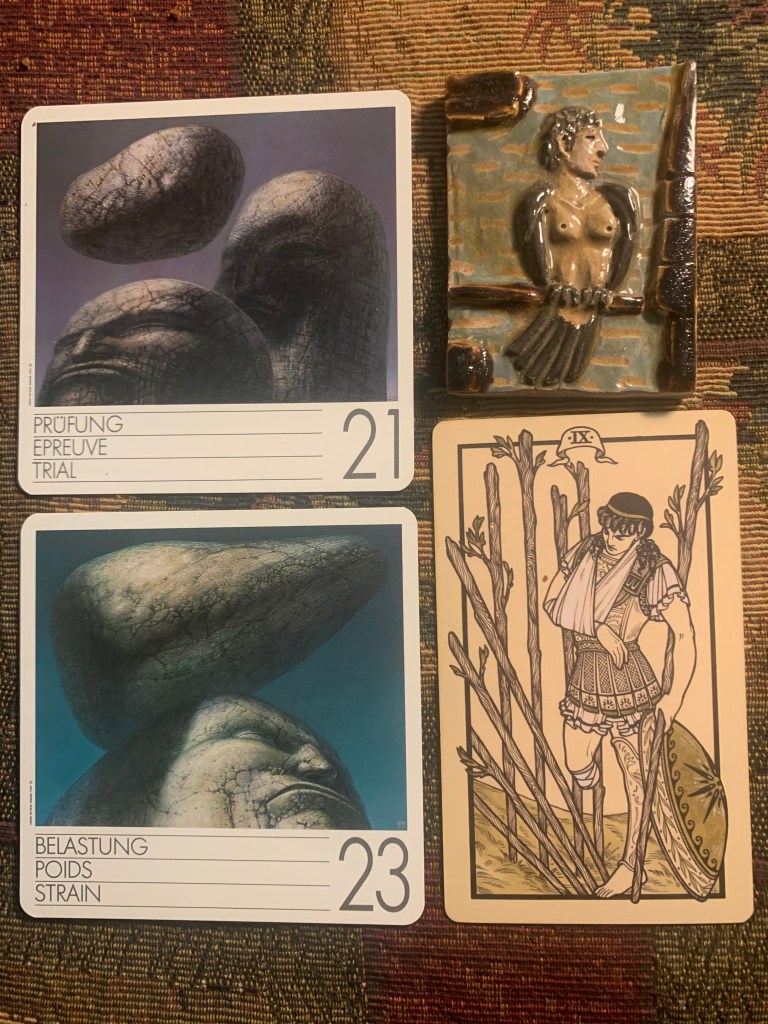
The Nine of Wands shows an injured man, clutching a wand. He looks over his shoulder towards the eight wands that loom over him. He seems weary and worn, as though he has already been through a battle and now must face additional challenges with the presence of these eight wands. As a Nine, though, this is his final challenge before reaching his goal; he must endure this last test of his strength and character before reaching the finish line.
Biddy Tarot
Louisa Lawson (1848-1920), mother of Australian writer and poet, Henry Lawson, was born on 17 February 1848 on Edwin Rouse’s station, Guntawang, near Mudgee, New South Wales. She was the second of twelve children of Henry Albury, station-hand, and his wife Harriet, née Winn, needlewoman. She was educated at Mudgee National School but had to stay home, under the eye of a tyrannical mother, and look after her siblings, instead of learning to teach.

To escape her mother, in 1866, she married a Norwegian-born handyman and gold digger. Between 1867 and 1877, Lawson gave birth to five children, but her husband, Peter, was often away at the goldfields or contract building. A long-suffering bush-woman, Lawson’s life was extraordinarily tough and manage with so little money and a husband who was frequently away. After her husband Peter finally left, she worked tirelessly to secure income for the family.

Mortality rates were high at this time. Louisa’s grief over the loss of one of her twin daughters is expressed in this poem.

A Mother’s Answer

You ask me, dear child, why thus sadly I weep
For baby the angels have taken to keep;
Altho’ she is safe, and for ever at rest,
A yearning to see her will rise in my breast.
I pray and endeavour to quell it in vain,
But stronger it comes and yet stronger again,
Till all the bright thoughts of her happier lot
Are lost in this one — my baby is not.
And while I thus yearn so intensely to see
This child that the angels are keeping for me,
I doubt for the time where her spirit has flown —
If the love e’en of angels can fully atone
For the loss of a mother’s, mysterious and deep.
I own that thought sinful, yet owning it — weep.

Louisa Lawson (1848 – 1920)

Lawson eventually moved to Sydney with her children in 1883 and Peter sent money irregularly. In 1888 she started Dawn and in doing so was the first female to establish a radical newspaper for women. She announced that it would publicise women’s wrongs, fight their battles and sue for their suffrage. It offered household advice, fashion, poetry, a short story and extensive reporting of women’s activities both locally and overseas. Perhaps most importantly it employed an all female workforce.

Project Gutenberg has a selection of lead articles that appeared in The Dawn.
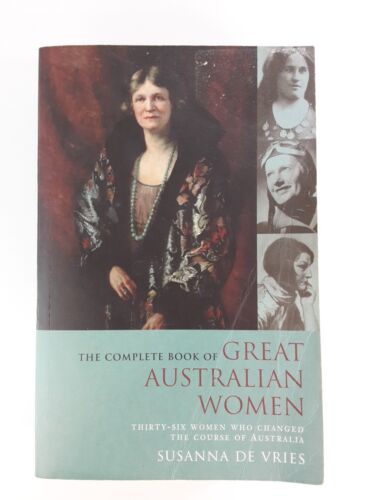
Of course none of this fully reveals just how tough journey was that led Louisa to her Opus Magnus, what is widely recognised as a significant publication and which to influenced women’s magazines such as the long running Australian Women’s Weekly.

In her book ‘A Collection of Great Australian Women’, Susanna De Vries leaves in no doubt about just what Louisa endured in her lifetime. Sadly, in her final years, after a debilitating fall from a tram she began to lose her memory and was admitted into a hospital for the insane. She died on August 12, 1920.

When the nine of wands appears upright, it indicates that you have a very strong determination and even during times of adversity, you don’t back down and face the challenge upfront. Even if you are tired and exhausted from the battles of life, your determination and persistence do not fail you and you use them to get what you want. The nine of wands stand as a witness to your struggles and appear when you feel battered and bruised. You are struggling to make progress, but just as you feel you are making it, you come across an obstacle

Posted in Matilda's, Narrative Therapy, Women's Health, Women's Stories

Isabel Letham – Three of Wands

There is so much magic in manifestation. So much alchemy. The Three of Wands is a reminder of that power. It’s a card for sorcery, witchcraft, spellwork. For calling on higher powers, stating intentions, and most importantly, working with the power of your own will. from Little Red Tarot

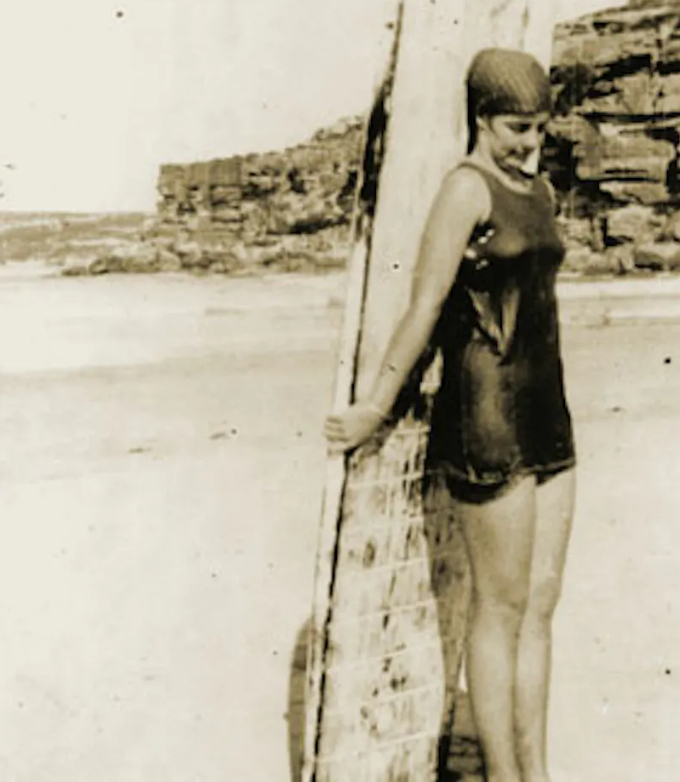
Some might be aware that surfing is said to have been introduced to Australia by the Hawaiian swimming champion, Duke Kahanamoku. What is less known is that he was accompanied in some of his momentous surfing demonstrations by a teenaged girl from Sydney’s northern beaches who, by tandem board-riding with Kahanamoku at Freshwater Beach in January 1915, earned the contested distinction of being the first Australian to surf.

That Isabel Letham’s name is little known outside the surfing world no doubt says something about the way the sport’s iconography of chiselled jaws and bare, bronzed pectorals has left little room for images of feisty femininity.

Emboldened by this Australian celebrity, Letham decided to try her luck on the silver screen. The US film industry was taking the world by storm, and Hollywood was the place to be. Leaving school at 16, Letham found employment as a sports mistress at elite girls’ school Kambala, and also worked as a private swimming instructor.

The Three of Wands is the threshold we stand on before we throw ourselves into the unknown, it is our opportunity to really assess what the best way forward is so that we can push on with confidence and self-assuredness. Often this position also comes with hesitation and a fear of doing something completely new, but we have to feel the fear and do it anyway.

By August 1918, she’d saved enough for a fare to California. The war was still raging but that was not enough to deter her. Still only in her teens, Letham set sail on the SS Niagara, the “Queen of the Pacific”. She travelled alone and with only the vaguest outline of a plan.

Joanna Gilmour explores the life of female Australian surfing legend Isabel Letham.

Three of Wands Energy

The Three of Wands urges you to step out of your comfort zone and embrace change. It encourages you to think long-term and be open to new experiences. By doing so, you can expand your horizons and achieve even greater success.

Posted in Matilda's, Memoir Writing, Narrative Therapy, Women's Health, Women's Stories

Minnie Berrington – The Fool’s Leap

New beginnings, innocence, naiveté, childlike trust, carefree enthusiasm, longing to find one’s heart desire, spontaneity, endless potential, inexperience, excitement, leap of faith, risk, reckless, the unknown

She came to Australia with her younger brother Victor on an early assisted passage scheme. Victor landed an adventurous job travelling the far reaches of SA with a hawker and “getting to see the true Australia”. He inspired Minnie to give up her job and come with him.

This is just the beginning! The Fool is Card Zero of the Major Arcana, representing the point where everything begins and ends and begins again. The Fool tarot card is a sign of unlimited and endless potential. It’s a cosmic invitation from the universe to start your next adventure. The world is your oyster, babe! Release your expectations or any preconceived notions because anything can happen right now, you just need to take a leap of faith and dive into the unknown

In 1925, London typist Minnie Berrington left her commonplace life for one of adventure and travelled to Australia with her brother Victor on an early assisted passage scheme. She went on to becoming the first female opal miner and postmistress in the harsh and unforgiving deserts of South Australia. From 1926, for over 20 years, Minnie was an opal mining pioneer in both Coober Pedy and Andamooka.

People always asked Minnie if she was ever afraid, living out in the desert alone with all those rough and scruffy men. But Minnie Berrington was not the faint-hearted type, and never had been. Being tough came naturally to her, growing up with three brothers and a family that went from riches to ruins. Only a slip of a girl, Minnie could match any man in stamina, perseverance and strength.

“A golden light suffused everything,” she wrote. “The air was so clear it seemed to sparkle and the hills were as sharp-cut as the ones that looked so impossible on the stage… The enchantment of that golden serenity was so complete that I knew I would never willingly live in a city again.”

She arrived in Coober Pedy when camels still brought in essential supplies, and water was so scarce that no-one washed. Together with the other miners, she braved the heat, the flies and the dust. Every day she waited for that special sound the pick made when it cracked opal. 

Minnie was not the first woman to be arrive at the Stuart Range Opal Field. Mary Halliday, the wife of an opal miner, preceded her as the first woman

Taking the Plunge

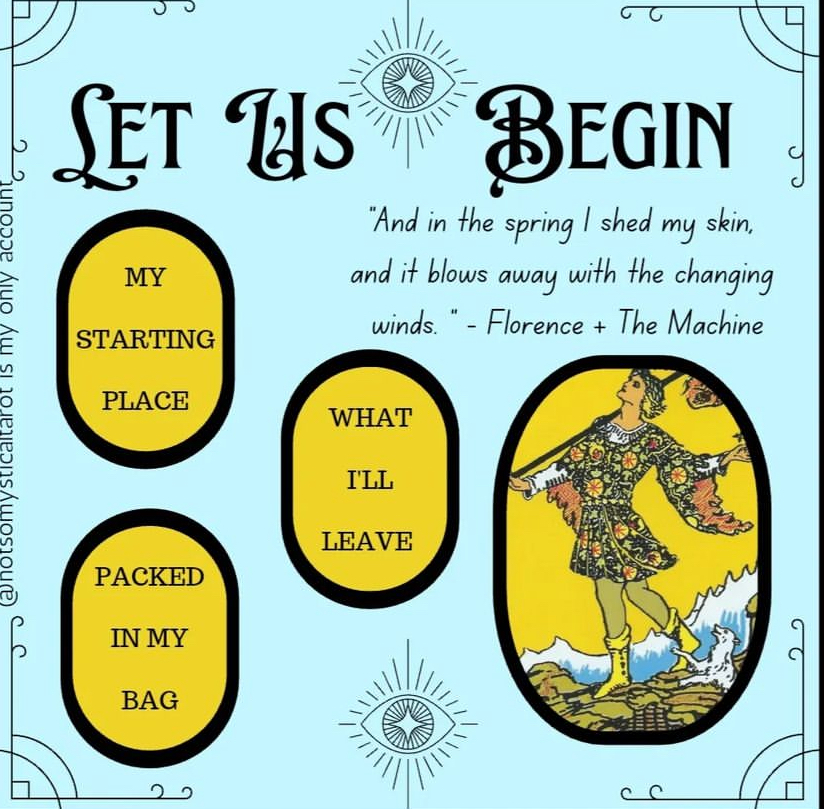
The Fool is a symbol of potential. He is often shown carrying a small bag which emphasizes his status as a wanderer. He embarks on his journey with nothing but pure faith in a higher power (and usually, a dog).

Spread by @notsomysticaltarot.

The Fool encourages you to take a leap of faith. If you have the right mindset, a fresh start awaits you. Take risks. Trust everything will work out in your favor at the end of the day.

There is beauty in innocence and spontaneity. You don’t always have to know what will happen next. It is okay to move on fearlessly even if you still don’t have the perfect plan.

Keep an open mind and open heart.

They Dared Take the Leap

Germaine Greer – Second Wave Feminist Author

Posted in Matilda's, Memoir Writing, Narrative Therapy, Women's Health, Women's Stories

Five of Swords – Isabella Mary Kelly

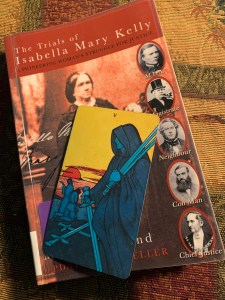
The Five of Swords is about a battle in which there are no winners – by the time someone had triumphed, it is over anyway. There may ‘officially’ be winner and a loser… but from over here it kinda looks like everyone lost.

The stories that have circulated about Irishwoman Isabella Mary Kelly are amazingly lurid. As recently as the 1970s and 1980s tabloid articles about her feature headlines such as ‘Female settler was tyrant to assigned lags’, ‘Wild ways of grazier Bella’, ‘Sex-hungry tyrant lived by law of the lash’ and ‘Isabella Kelly — a bitter, sadistic hellcat of a woman’. This forensically researched books dispels these outrageous claims and honours her memory.

Isabella Mary Kelly (no relation to Victorian bushranger Ned Kelly) was born in Dublin, and arrived in Australia in 1835, a wealthy single woman in a man’s world. Kelly was surely the only woman who alone in those wild days took up virgin forest for settlement as a pioneer in Australia. She was the first, or one of the very first, ‘free’ selectorson the land north of the Manning. 

Isabella ran her  property herself, using assigned convict labour.  Isabella was disliked by her male counterparts who lived nearby and was eventually accused and convicted of a crime she did not commit She struggled to prove her innocence and obtain justice.

When this card appears in a reading it calls upon you to think about the areas of conflict in your life. Is the fight still worth it? Was it ever worth it at all? The truth is that old grudges eat up our energy, take up brain space and cause you pain and harm. Sometimes it is better to just walk away – even if that means admitting defeat?

In this case however, Isabella, accused amongst other things of being a gun-toting wildcat. does need to have her name cleared. Stories concerning Miss Kelly’s heart-less doings in those wild days have been many, and particularly outrageous tales have easily been attached to this ‘Pioneer in Skirts,’ for she seems to have had very few friends to advocate her cause.

Read the printed material of the tme and you would be led to believe that she was a masculine, evil-minded, ill-tempered, unnatural sort of individual. For instance, it is alleged that she shot down convicts with the two big old horse pistols, that she carried at her belt; that she murdered her maid servant in her tantrums; and even drove chained convicts 50 miles on foot, to Port Macquarie to be flogged after they had saved her own life in a swollen river. 

Such stories are outrageously libellous to her memory, one even accusing her of flogging men to within an inch of their lives for refusing her favours. Most of these accounts end with Kelly receiving her just desserts by dying as an impoverished beggar living in a cellar in Sydney’s dockland in the 1890s.

The truth is less spectacular. Kelly successfully managed her property herself, becoming a noted breeder of horses. Current thinking about Kelly is that she was greatly resented for the free lifestyle she led as an unmarried woman. Posthumously, The Trials of Isabella Mary Kelly, by Maurice Garland offers a different picture of this spirited individual and provides some justice for Isabella. It reveals the lengths her adversaries went to and shows just what a stoic female pioneer she was.

Isabella died in Sydney in 1872, not wealthy but certainly not a beggar. She is now recognised in the Manning River area as a pioneer woman of great determination and ability.

More Five of Swords Women