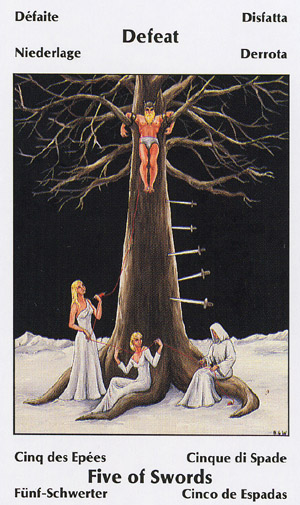
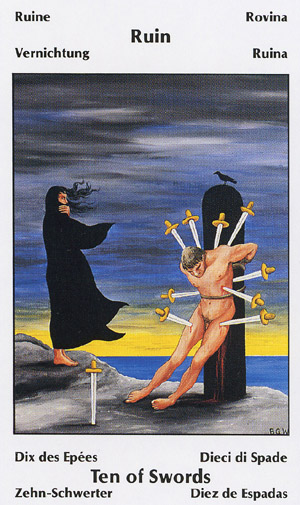
There is little positive to say about the five of swords, especially at this time in history as we witness the horrors in active war zones. There is even less that is positive if you lay Barbara Walker’s Five of Swords alongside the Ten of Swords. It’s about a battle in which there actually are no winners – by the time someone had triumphed, it was over anyway. There may ‘officially’ be winner and a loser… but from over here it doesn’t look like anyone is triumphant. And then there are the ongoing ripple effects of what has been done.
During their school years the majority of Australian students are not taught about the Indigenous massacres on Australian soil or are able to gain an understanding of what the stolen generation is all about. Even if they do watch ‘Rabbit Proof Fence’ or hear about these horrors. there are disturbing truths about the aftermath of all these actions that need to be acknowledged. It takes courage to look dispassionately at this stuff and understand the trails of trauma that have shaped so many lives.
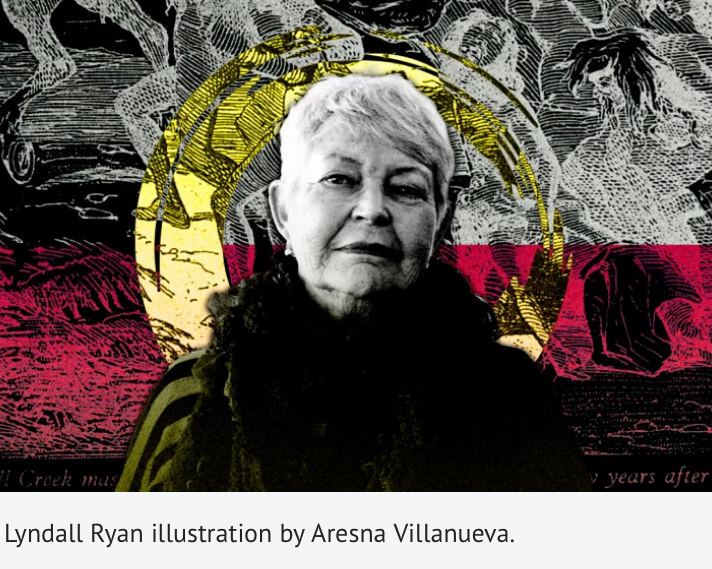
The daughter of Edna Minna Ryan (1904–1997) a committed feminist, communist and trade unionist, Emeritus Professor Lyndall Ryan believes that she was bestowed with a responsibility to present available facts and figures about indigenous massacres in Australia. It is her wish to present material in such a way that helps people understand and come to terms with the events of the past.
For the past eight years this 79-year-old and her research team have upheld an unwavering commitment to uncover and confirm the truth about Australia’s early colonial history.
It’s been an endeavour that has unearthed confronting and deeply disturbing details of the colonial frontier massacres of Aboriginal and Torres Strait Islander people.
The image of the 5 of Swords is usually depicted with a person who has captured the swords of his adversaries who are leaving, rejected and lost. There are storm clouds in the background. This card shows that you might be the conqueror or the conquered. But neither position has actually won. This battle was pointless, it was unfair and it was full of cowardliness. Basically, this is not one of the higher points of life.
The research project’s fourth and final stage’s recently released findings now estimate more than 10,000 Aboriginal and Torres Strait Islander people’s lives were lost during at least 414 massacres committed during the period 1788 to 1930.
Evidence also shows around half the frontier massacres were carried out by colonial officials, such as police and soldiers, either solely, or in conjunction with settlers and/or their employees.
And unexpectedly, the attacks during the spread of pastoral settlement in Australia did not decrease as the decades passed; they intensified. More massacres occurred in the period 1860 to 1930 than in the earlier period of 1788 to 1860.

