Posted in Matilda's, Memoir Writing, Narrative Therapy, Women's Health, Women's Stories

Phyllis Kaberry – Anthropologist

When you get the Strength card in an upright manner during your tarot reading, it shows that you have inner strength and fortitude during moments of danger and distress. It shows that you have the ability to remain calm and strong even when your life is going through immense struggle. It also shows that you are a compassionate person and you always have time for other people even if it’s at your own expense.

Phyllis Kaberry, unlike Margaret Mead, is not listed as one of the top female anthropologists. No doubt because of gender bias her ethnography did not receive the attention that it deserved when it was first published but her work is every bit as fascinating as Meads.

Kaberry was born in the United States in 1910 and moved with her family to Sydney at the age of ten. Educated in Australia she was the first Australian woman to be recognised as a fully trained and qualified anthropologist. She achieved several other ‘firsts’ along the way: she was the first female Australian anthropologist to complete doctoral work, which she did at the London School of Economics in 1938, and the first who took a particularly woman-focused approach to her field work and theories.

Kaberry was a social anthropologist who dedicated her work to the study of women in various societies. Particularly with her work in both Australia and Africa, she paved the way for a feminist approach in anthropological studies.

She was an outstanding and disciplined fieldworker, to judge from my experience, well and critically apprised of the existing documents, and with a brilliant sympathy for the perplexities and moral dilemmas of chiefs, local political leaders, catechists, conservative lineage-heads, tax-collectors, traders, what you will. Her evident integrity attracted a rich deposit of information on social change in this area which may be of capital importance for the future. Her field-notes have been left to the British Library of Economics and Political Science.

Rai Organisation

Kaberry was encouraged by A. P. Elkinan early figure in Australian anthropology and history to work in the Kimberley. Elkin had noted that there was very little understood by outsiders about Aboriginal women and that only half the Aboriginal story was being told. Her main findings were published in 1939 in Aboriginal Woman Sacred and Profane. During her time in the field, she received an Aboriginal name, Nadjeri, and the memory of her stay “has been recorded into a number of indigenous historical narratives” (Toussaint 2002 ; Williams 1988). She was the first researcher to focus on the lives of Aboriginal women (Williams 1988) and her work garnered considerable public as well as academic attention.

Kaberry spent almost two years in the Kimberley travelling from the west to east. She spent most of her time around Moola Bulla near Halls Creek, Fitzroy Crossing, Forrest River, Turkey Creek, and some of the Dampier Land communities. She travelled extensively with Aboriginal people, walking or riding a mule, was allocated the sub-section or skin group of ‘Nadjeri’, and took her social incorporation and obligations very seriously. Kaberry was interested in languages and seemed to quickly learn the different languages encountered on her travels. When talking with Aboriginal people who knew Kaberry, Dr Toussaint found that she is remembered with respect and affection. She has recorded a number of stories about Kaberry’s travels with Aboriginal people.

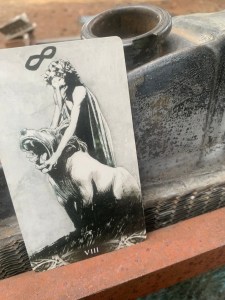
The Strength card is a symbol of inner fortitude, which helps us prevail in the face of life’s challenges. Strength is something that needs to be reinforced every day. Just as muscles need to be continuously used to maintain their power, so too does inner-strength need to be habitually exercised.

Newspapers of the time published a number of articles about Kaberry and her research. 

Newspaper Articles

Note that the kind of tabloid writing at the time would be deemed offensive now. This is not a reflection on Kaberry’s work but does reveal her courage and determination and capacity to patiently complete her work.

Posted in Matilda's, Memoir Writing, Narrative Therapy, Women's Health, Women's Stories

Strength – Olympias the Deaconess

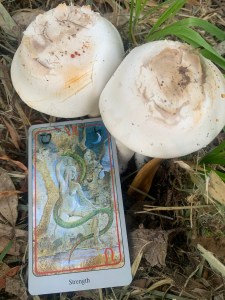
A mushroom’s power and strength is not obvious. But it is actually calling lots of the shots.

For a long time, mushrooms have been considered strange and mysterious creatures. They come in all shapes and sizes and can grow in the darkest and dampest corners of the world. In a sense, mushrooms thrive in environments where they may otherwise be destroyed.

Women, like mushrooms, are remarkably varied in their attributes and historically have often been required to suppress their identities and survive in hostile environments. Akin to mushrooms they often must grow below the ground’s surface: hide their talent under a bushel so to speak.

Mushrooms have the power to transform things. They can grow by decomposing organic matter, breaking it down, and creating new life. They can teach us about community, connection and renewal. Likewise there is much to learn from the long hidden women from history. These women can guide us and help transform society by reminding us to challenge and breaking down harmful norms and stereotypes.

Olympias, the Deaconess, (not Alexander the Great’s mother) was a formidable woman who opposed the emperor and fought for her way of life and her faith. Olympias was the daughter of the senator Anicius Secundus, and by her mother she was the granddaughter of the noted eparch Eulalios.

Before her marriage to Anicius Secundus, Olympias’s mother had been married to the Armenian emperor Arsak and became widowed. When Saint Olympias was still very young, her parents betrothed her to a nobleman. The marriage was supposed to take place when Saint Olympias reached the age of maturity. The bridegroom soon died, however, and Saint Olympias did not wish to enter into another marriage, preferring a life of virginity.

After the death of her parents she became the heir to great wealth. A fifth century CE text presents Olympias as a determined young woman who was not afraid to advocate for herself and fight to live her chosen way of life. She chose to live a celibate life and began to distribute her wealth to all the needy: the poor, the orphaned and the widowed. She also gave generously to the churches, monasteries, hospices and shelters for the downtrodden and the homeless.

Olympias was fueled by an inner strength, personal power, strong will and determination. Given that she did not try to control others; but quietly influenced and persuaded, highlights her strength. Her power was not to be underestimated when it may have appeared so ‘invisible’. She proved able to can control a situation without excessive, outward force. No on possibly cottoned on to how she was actually calling the shots.

Journal Ideas

  • Get out in nature and find some mushrooms. Photograph these gentle creatures and spend time interviewing them about the meaning of life.
  • What lesson do you take from Mushrooms, the Strength card and Olympias?


Posted in Matilda's, Memoir Writing, Narrative Therapy, Women's Health

Strength – Robyn Davidson

The Strength card is a symbol of inner fortitude, which helps us prevail in the face of life’s challenges. Strength is something that needs to be reinforced every day. Just as muscles need to be continuously used to maintain their power, so too does inner-strength need to be habitually exercised.

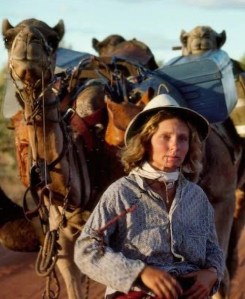
The ‘Camel Lady’, Robyn Davidson, with her beloved dog, Diggity, and four camels, trekked 2700 kilometres across some of Australia’s most remote and inhospitable deserts, from Alice Springs to the Indian Ocean, in 1977.

Davidson wrote about her 1,700-mile journey across the deserts of Western Australia in her bestselling memoir Tracks. She painted an intimate portrait of the experience of solitude and loneliness in a context where life has lost all its previous forms, a concept more of us can relate to since the pandemic. She went weeks on end without seeing anyone, navigated miles of arid desert without water, slept under the stars and fended off poisonous snakes and aggressive bulls charging towards her.

Strength’s tarot meaning is one of my favourites because it has a very potent, supportive energy that lets you know that you can do what needs to be done. That you have the inner strength to push through whatever is holding you back or causing you pain and negativity right now.Self Care Emporium

Tarot Memoir

From the Murder of Crows Tarot

The Strength card represents strength, determination, and power – like The Chariot. However, while The Chariot signifies outer strength and will, the Strength card speaks to the inner strength and the human spirit’s ability to overcome any obstacle. Strength is about knowing you can endure life’s obstacles. You have great stamina and persistence, balanced with underlying patience and inner calm. You are committed to what you need to do, and you go about it in a way that shows your composure and maturity. Biddy Tarot

the quality or state of being physically and emotionally strong.

  • Write about a time when you needed to show great fortitude.
  • Examine the life of an ancestor and consider the fortitude they needed in order to survive. What do you learn from them?
  • Women like my great great grandmother were sentenced for petty crimes and transported to Van Dieman’s land. They certainly needed fortitude to survive the journey and life in the early colony. Read about more of these women.
  • Write a portrait of a woman whose sheer strength of will and courage you admire.