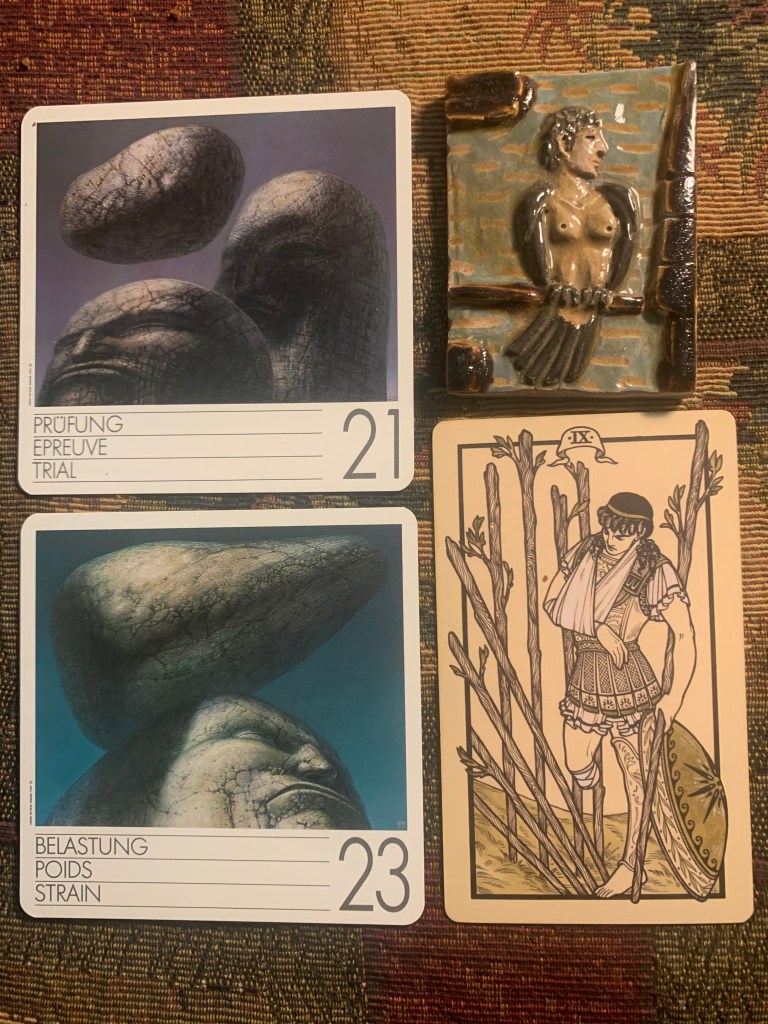
The Nine of Wands shows an injured man, clutching a wand. He looks over his shoulder towards the eight wands that loom over him. He seems weary and worn, as though he has already been through a battle and now must face additional challenges with the presence of these eight wands. As a Nine, though, this is his final challenge before reaching his goal; he must endure this last test of his strength and character before reaching the finish line.
Biddy Tarot

Louisa Lawson (1848-1920), mother of Australian writer and poet, Henry Lawson, was born on 17 February 1848 on Edwin Rouse’s station, Guntawang, near Mudgee, New South Wales. She was the second of twelve children of Henry Albury, station-hand, and his wife Harriet, née Winn, needlewoman. She was educated at Mudgee National School but had to stay home, under the eye of a tyrannical mother, and look after her siblings, instead of learning to teach.
To escape her mother, in 1866, she married a Norwegian-born handyman and gold digger. Between 1867 and 1877, Lawson gave birth to five children, but her husband, Peter, was often away at the goldfields or contract building. A long-suffering bush-woman, Lawson’s life was extraordinarily tough and manage with so little money and a husband who was frequently away. After her husband Peter finally left, she worked tirelessly to secure income for the family.
Mortality rates were high at this time. Louisa’s grief over the loss of one of her twin daughters is expressed in this poem.
A Mother’s Answer
You ask me, dear child, why thus sadly I weep
For baby the angels have taken to keep;
Altho’ she is safe, and for ever at rest,
A yearning to see her will rise in my breast.
I pray and endeavour to quell it in vain,
But stronger it comes and yet stronger again,
Till all the bright thoughts of her happier lot
Are lost in this one — my baby is not.
And while I thus yearn so intensely to see
This child that the angels are keeping for me,
I doubt for the time where her spirit has flown —
If the love e’en of angels can fully atone
For the loss of a mother’s, mysterious and deep.
I own that thought sinful, yet owning it — weep.
Louisa Lawson (1848 – 1920)
Lawson eventually moved to Sydney with her children in 1883 and Peter sent money irregularly. In 1888 she started Dawn and in doing so was the first female to establish a radical newspaper for women. She announced that it would publicise women’s wrongs, fight their battles and sue for their suffrage. It offered household advice, fashion, poetry, a short story and extensive reporting of women’s activities both locally and overseas. Perhaps most importantly it employed an all female workforce.
Project Gutenberg has a selection of lead articles that appeared in The Dawn.
Of course none of this fully reveals just how tough journey was that led Louisa to her Opus Magnus, what is widely recognised as a significant publication and which to influenced women’s magazines such as the long running Australian Women’s Weekly.
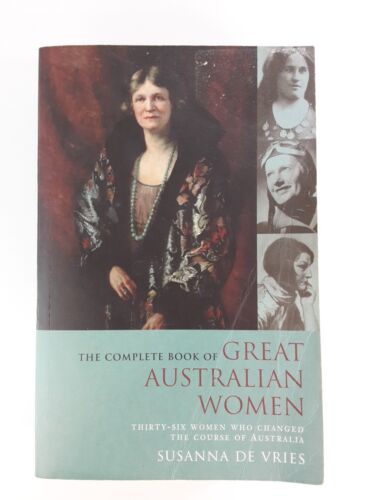
In her book ‘A Collection of Great Australian Women’, Susanna De Vries leaves in no doubt about just what Louisa endured in her lifetime. Sadly, in her final years, after a debilitating fall from a tram she began to lose her memory and was admitted into a hospital for the insane. She died on August 12, 1920.
When the nine of wands appears upright, it indicates that you have a very strong determination and even during times of adversity, you don’t back down and face the challenge upfront. Even if you are tired and exhausted from the battles of life, your determination and persistence do not fail you and you use them to get what you want. The nine of wands stand as a witness to your struggles and appear when you feel battered and bruised. You are struggling to make progress, but just as you feel you are making it, you come across an obstacle