The Seven of Swords shows a man sneaking away from a military camp with five swords in his arms. He looks over his shoulder at the two upright swords he has left behind. The smile on his face suggests that he is proud of himself for having slipped away without being noticed.

The subtlety of the After Tarot Seven of Swords is inspired. Here we see that our deceptive thief is not as clever as he thinks, and that he is about to be tripped up, his deception revealed. Over recent years many men, who have taken credit for women’s work, have been exposed. In fact the phenomenon is so common that the term the ‘Matilda Effect’ was coined to describe it.
In her book, Women Scientists in America, Margaret Rossiter brought to light the work and contributions of hundreds of women in science that were either forgotten or buried. As an academic historian, Rossiter excavated the lives of forgotten chemists, astronomers, physicists, and botanists.
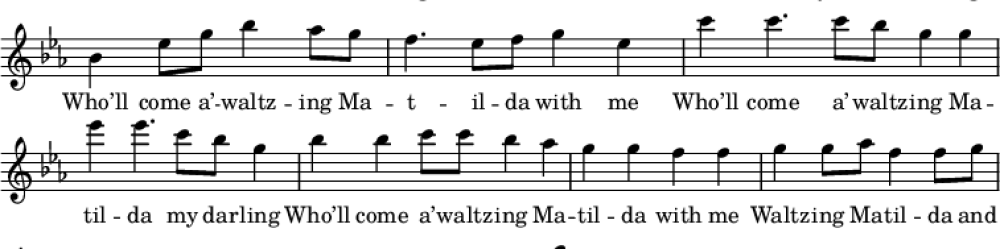
Not surprisingly the Matilda Effect has been alive and well in Australia. Perhaps ironically, Waltzing Matilda which is, indisputably, Australia’s most popular folk song and bush ballad has a story of deception hidden the score.
Andrew Barton “Banjo” Paterson, journalist, author and bush poet, is said to have written the lyrics during a visit on Dagworth station near Winton, Queensland, in 1895. However, he has also been attributed as having written the score.
While it is indisputable that he did write the lyrics, the unsung hero, who played him the first score on her zither (auto harp) during a visit on a Queensland sheep station, was Christina Mcpherson. Her contribution was not discovered until 1991 when a music sheet in her handwriting was found. These records demonstrate that Christina played a vital part in the composition of Waltzing Matilda and without her contribution, there would have been no song called Waltzing Matilda. However, she remains unknown to most Australians.
History is littered with stories about women who have seen their accomplishments claimed by men. ‘Colette’, starring Keira Knightley and Dominic West is just one recent film that exposes how men have taken the credit for women’s work. Fortunately, she went on to be recognized as the a giant in French Literature but others have been relegated to obscurity. By contrast, Eileen Orwell, wife of George Orwell and the subject of Anna Funder’s ‘Wifedom’, like the women in the Magician’s box, disappeared into obscurity.

Christina Rutherford Macpherson was born on 19 June 1864 at Peechalba Station (near Wangaratta), Victoria, Australia. She was the ninth of eleven children born to Ewen Macpherson and his wife Margaret Brown Rutherford who had migrated to Australia from Scotland around 1854. Peechalba Station, a property of about 150,000 acres was jointly owned by the Macphersons and Rutherfords who had homesteads close to each other.
Her story is one which screen writers could have a field day with. Macpherson may not be compared to Colette, Mary Shelley, Eileen Orwell or the women in science whose work was forgotten and buried, but it is another example of how some deserving slip into obscurity, deceived by men who they were infatuated with.
 Waltzing With Matilda's