It is not surprising, given that life can often feel like a fight, that when readers consider the wands suit they often talk about battles. Everyone has, at some point in time, been called on to speak out, stand up for themselves or overcome the inner voice that can feel like the greatest force of oppression
The Seven of Wands is perceived to be an activist’s card and a woman like Lowitja O’Donoghue, who has fought tirelessly for Aboriginal rights, is the kind of person who might come to mind. For some of us the Seven of Wands might help us understand our fight for survival in a society that doesn’t accept our existence. For others, it is about standing tall and getting our message out there so it can be heard.
In some decks, we see a physical battle. A person standing alone, their single wand held high, fighting a sea of faceless others. This is how it can feel sometimes, when we are called to defend our truths or overcome the seemingly insurmountable.
Other decks, like the Light Seers Tarot by Chris Anne represent the Seven of Wands differently. A card like hers can be interpreted as depicting a defiance and taking a stand that changes the energy flow.
A person, who could be perceived to have defiantly faced what seems like a truly insurmountable battle and changed the flow, is Turia Pitt.
In 2011, age 24, Turia was an ex-model, fitness fanatic and successful mining engineer when she was caught in a freak firestorm while competing in a 100km ultramarathon in Western Australia. She was choppered out of the remote desert barely alive, with full thickness burns to 64 percent of her body.
“Simply AMAZING! Turia’s presence on the stage captivated our audience. Her ability to overcome the physical trauma of her experience and then battle through the mental and emotional challenges that followed is justly inspiring. Turia was able to share her brave story with connection to our audience, who were completely silent for the duration, until the end when Turia was given a 100% standing ovation. Turia is a truly remarkable human. We would recommend Turia as an inspirational or motivational speaker with absolute enthusiasm.” Place Conference
Surviving against overwhelming odds is the least of her achievements. Turia has gone on to thrive in the ultimate story of triumph over adversity. Pitt is living proof that, with the right mindset, anything is possible.
“The Seven of Pentacles represents the not-so-distant days of our ancestors when everything was grown and made by hand.
Before large-scale farming and manufacturing existed, people toiled day in and day out. They worked in difficult, and sometimes dangerous, conditions to provide for their families. For most, the goal was to make it to harvest season.
During harvest time, the crops could finally be gathered and sold. All of the planning and hard work manifested into fruits and vegetables of their labor. What once were small seeds in the ground became coins in their pockets.
Although few of us actually work in the agricultural business today, the message of the Seven of Pentacles still remains the same: long-term success is near if you are willing to put in the work”. Source: Little Spark of Joy
The Seven of Pentacles unquestionably represents accomplishments we have earned through the investment of blood, sweat and tears. It is eye wateringly unbelievable that until 1994 Australian women who worked farms could not declare that their occupation was farmer. Instead they were identified as farmer’s wife, or providing home duties. It is especially amazing given the significant contribution women have made to agriculture since colonisation.
In 1844 Dr Christopher and Mary Penfold arrived in the new world onboard the Taglioni with a vine cutting and a bold vision. A doctor, with an eye for medicinal winemaking, Penfold and his wife, Mary sought a new life filled with hope and prosperity.
The family purchased 500 acres of ‘the choicest land’ in early colonial South Australia. Here, Christopher planted vines and set in motion philosophies that remain with us to this day and set about inventing tonics, brandies, and fortified wines made from grapes and Australian sunshine.
The 7 of Pentacles indicates that you recognise the importance of investing time and effort now to reap long-term benefits and that you have a deep willingness to invest in long-term success. You’re not trying for instant gratification. You may want to make sure you’re focusing your efforts on the correct places rather than spending time and money on projects that won’t help you achieve your goals
Christopher was seen at the forefront of the winery. The Australian Wine Industry, in its wisdom, believed that the founder of Penfolds Wines and the Maker of the World famous Grange Hermitage should never be a woman and said that Dr Christopher Penfold was responsible for it all.
However, it was certainly not Dr Christophe Penfold who was responsible for the enormous success of Penfolds. He devoted most of his time to being a doctor. It was actually Mary Penfold who was the unsung chief of Penfolds. She was responsible for many of experimentations, growth and winemaking philosophies. Everything she knew about wine, she taught herself – insisting on having the grapes blended to her own taste. A woman standing confidently at the helm of a thriving business in the 1800s was unheard of. She’d command from a white mare, watching over the vineyard with her treasured spyglass close at hand.
“Emotion and imagination can produce wonderful visions, but without grounding in both action and the outer realities of life these fantastic images remain daydreams, ‘fancies’ without real meaning or value. … They lack meaning because they don’t connect to anything outside of themselves”. Rachael Pollack
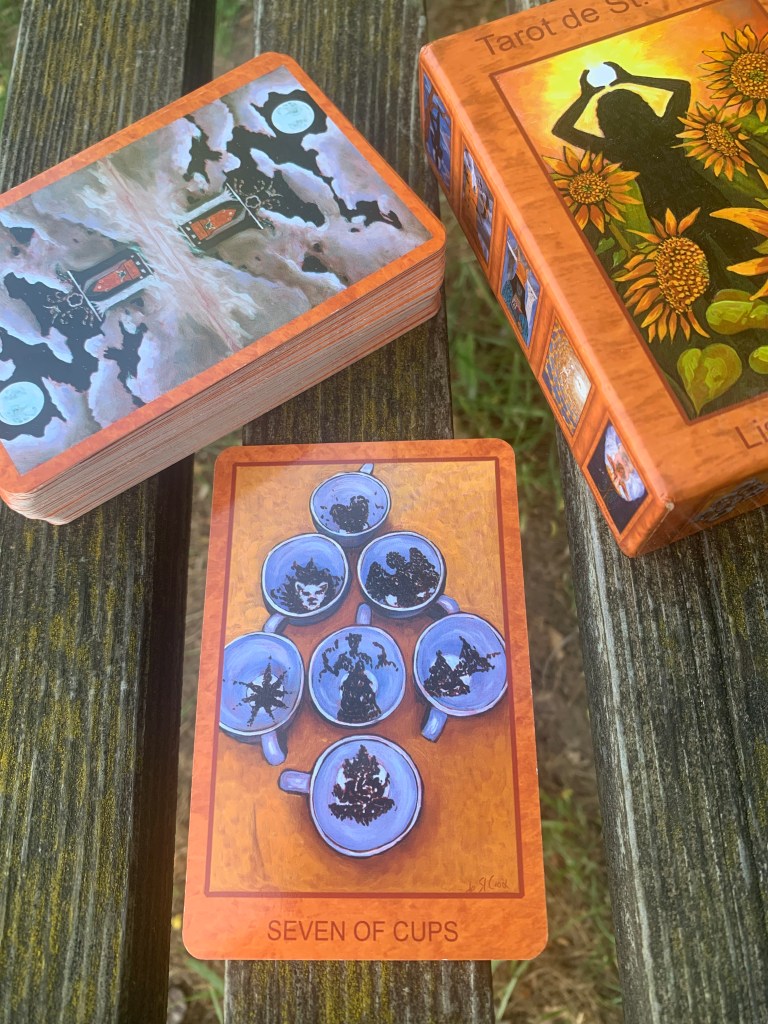
Traditionally the Seven of Cups shows cups filled with various gifts. Biddy Tarot writes that “some cups bear desirable gifts such as jewels and a wreath of victory. But others hold gifts that are not gifts at all; instead, they are curses, such as the snake or dragon. The clouds and the cups symbolise the man’s wishes and dreams, and the different gifts inside suggest that you need to be careful what you wish for as not everything is as it seems”.
By contrast, this rendition by Lisa de St Croix features tea leaves, which she notes depict fantasies, hopes and dreams. In a world where material wealth is so unevenly distributed its worth taking moment to introduce seven Australian philanthropists in the hope that something flows from their cups of generosity and commitment. Be in no doubt! These women acted on their dreams.
Australian women’s philanthropy has its roots in charitable work. Nineteenth-century women who, like Lady Clarke, were able to supplement their voluntary work with large financial contributions were few and far between, and were inevitably the wives and daughters of wealthy men. Australia did not have the aristocratic wealth of the United Kingdom, where Baroness Angela Burdett-Coutts gave away close on £3 million before the turn of the century. Nor did it have the vast wealth of the industrialising United States, allowing twelve women philanthropists in Chicago alone to give nearly $800,000 to charitable causes in the 1880s.
However this is not to diminish what Australian women have contributed to Australian society.
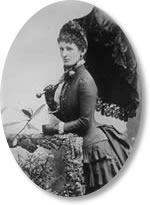
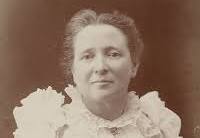
Janet Marion Clarke was born in 1851, the eldest daughter of pastoralist and later parliamentarian Peter Snodgrass and his wife Charlotte. Educated, apparently at home, in literature and the classics, she rose to prominence in 1873 when she became the second wife of wealthy pastoralist, William Clarke, who had previously employed her as a governess to his children. Schooled in her responsibilities by Lady Bowen, wife of the Victorian Governor, she used the family property at Rupertswood and their East Melbourne mansion, Cliveden, to establish herself as a society hostess. By the beginning of the twentieth century, the now widowed Janet, Lady Clarke was at the head of many philanthropic enterprises in Melbourne. Bestowed with the title, Lady Bountiful, Janet Marion Clarke was upheld as the ultimate example of beneficence in a human being.
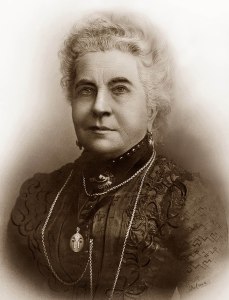
Lonely and in many ways shy, Ann Fraser made few close friends, but to those in need, especially the Aboriginals, she showed compassion and generosity. Dispossessed members of the Taungerong tribe had found a refuge at Wappan; in the 1860s they were resettled at Coranderrk near Healesville, but on their annual return for shearing they kept Mrs Bon informed of their treatment by the Board for the Protection of the Aborigines. Her home at Kew was a refuge for the sick and needy and she regularly visited Aboriginal patients in Melbourne hospitals.
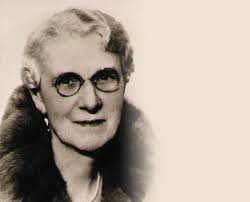
Dr Lucy Gullet may have been a socialite but she was also a socially conscious woman. Lucy Gullett ran a private practice in North Sydney from 1912. She was a physician to the Renwick Hospital for Infants 1918-1932 and founded the New South Wales Association of Registered Medical Women in 1921 and the Rachel Forster Hospital in 1925. The Rachel Forster Hospital, offered training for female medical students and catering to the needs of ‘home-tied’ mothers.
Initially directing her philanthropy towards saving infant life, in 1874 Lady Mary Windeyer supported a foundling hospital—to ‘remove temptation to infanticide’—and its reorganization in 1875 as a home (later Infants’ Home, Ashfield) for destitute and homeless new mothers, provided they remained in residence to breastfeed their babies. For older children in need of care, she favoured ‘boarding out’ from orphanages, a system which her friend Caroline Emily Clark had begun in South Australia.
Mary Raine’s story is inspirational. Her humble beginnings were an unlikely launching pad for the success and wealth she came to achieve in her lifetime. Through hard work and the application of business acumen rarely seen in a woman in the early years of the 20th century, Mary Raine went on to build a large real estate empire.
She was a visionary and saw the establishment of the Raine Foundation as a unique opportunity for her life’s work to live on in perpetuity – to grow and develop into something more important and more valuable than the business success and wealth that she had personally achieved. She did this by giving scientists and clinicians the means and opportunity to embark on medical research and to seek answers to questions that were not known in her lifetime. This gift has seen outstanding results and better health outcomes in medical research and will continue to grow and benefit future generations of medical scientists while providing better health outcomes for the general community.
Una B. Porter (née Cato) was a renowned psychiatrist, philanthropist and devotee of the Methodist Church in Melbourne, Victoria. She was the first female member of staff at Ballarat Mental Hospital in 1946. In 1963 she was elected World President of the YWCA and travelled extensively. In recognition of her services to the community she was appointed Officer of the British Empire (OBE) in 1961, and Commander of the British Empire (CBE) in 1968.
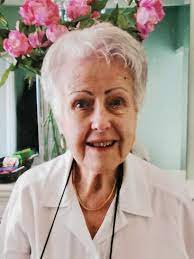
Meriel Wilmot-Wright has dedicated her life to making the world a better place. Wilmot-Wright was the first full-time research officer appointed by an Australian foundation. She transformed the Foundation and the nature and administration of philanthropy in Australia. Most notable was the introduction of the concept of seed funding, providing an initial grant and persuading others to continue support for particular projects, such as the Aborigines in Australian Society Project, subsequently continued by the Social Science Research Council.
In 2021, aged 100, she ensured her legacy of giving will last for generations by leaving a gift to her own Named Fund.
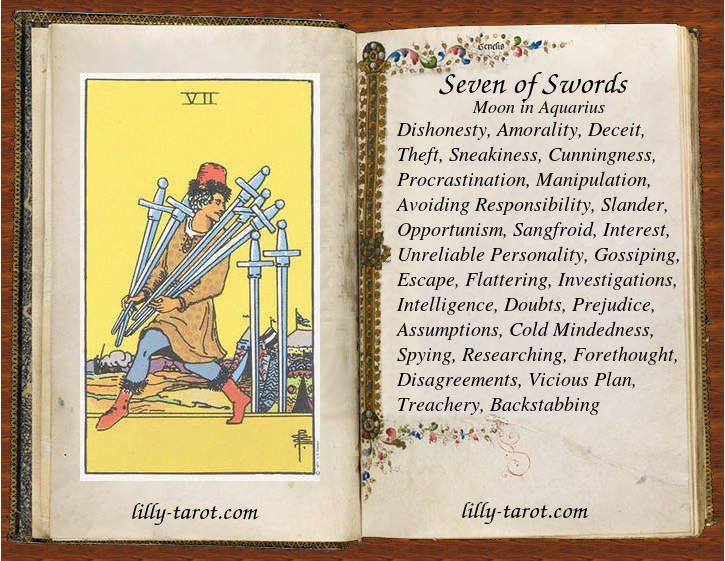
There are many reasons why people might lie, or hide the truth. You may be afraid to be yourself. It may not be safe to tell the whole truth. The Seven of Swords is about what you – or someone else – is/are hiding or holding back, and asks you to consider why.
This card can be about straight-up dishonesty or theft. Underhand tactics or sneaky behaviour. It shines a light on areas of our lives where dishonesty is present, asking us to confront them, to deal with whatever is going on.
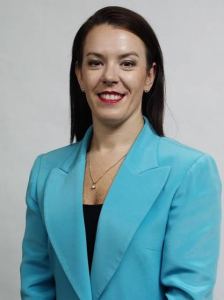
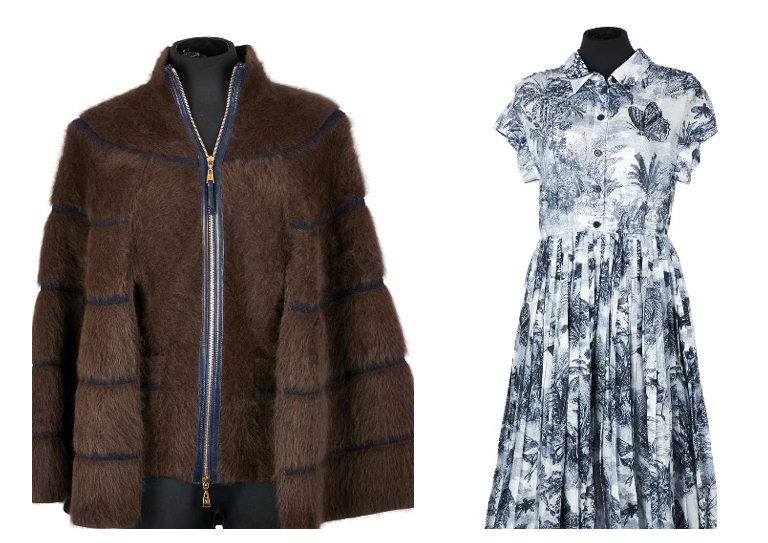
Melissa Caddick allegedly swindled her clients out of an eye watering $23 million dollars, misappropriating investor money of family and friends to fund a lavish lifestyle, buying luxury items including jewellery, watches, designer clothing and shoes.
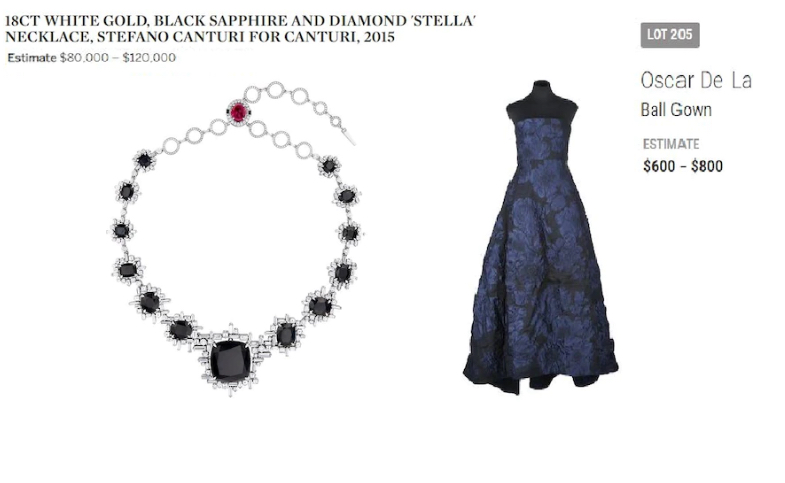
In the image below Caddick is seen enjoying the good life. She looks very like the Nine of Pentacles as she shows off a designer gown and sapphire and diamond jewellery estimated to be worth $100,00.
Of course the thing about the Seven of Swords, or the Nine of Pentacles for that matter, that is prudent to remember, is that things can change very quickly. Caddick’s world came crashing down when the ASIO came investigating. She vanished just hours after the Australian Federal Police and Australian Securities and Investments Commission raided the home. She was declared dead four months after her disappearance in February 2021 when a decaying foot was found on a beach 400km south of Sydney.
Designer clothing, art, luxury goods and jewellery belonging to Caddick have since been sold for $860,000 at auctions in Sydney.
Pages are also known as the messengers – they deliver a message, a positive one, that represents a solid beginning of some sort.
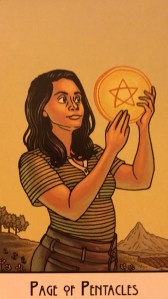
The Page of Pentacles, as the Light Seers Tarot explains, has a childlike quality, asks questions, is curious and adventurous, interested in the world around her. She looks carefully at her surroundings, her body, her environment and enjoys studies.
Pages represent youth and immaturity. In the Tarot de St Croix Lisa de St Croix chooses to feature her son approaching his work with youthful zeal exuberance. This Page is focused and concentrating. He is on an artistic mission, intent on capturing an image. Here, the Page, depicted in the This Might Hurt Tarot is focused and contemplating a fresh project. No matter our age fresh projects await.
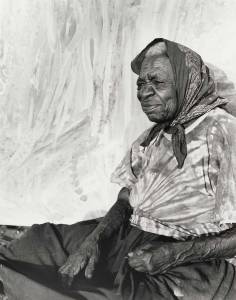
“Emily Kame Kngwarreye is one of Australia’s most significant contemporary artists. Emily was born at the beginning of the 20th century and grew up in a remote desert area known as Utopia, 230 kilometres north-east of Alice Springs, distant from the art world that sought her work.
Although Emily began to paint late in her life she was a prolific artist who often worked at a pace that belied her advanced age. It is estimated that she produced over 3,000 paintings in the course of her eight-year painting career – an average of one painting per day.
Her remarkable work was inspired by her cultural life as an Anmatyerre elder, and her lifelong custodianship of the women’s Dreaming sites in her clan Country, Alhalkere”.
Working with the Page of Pentacles
In an article entitled A Spread for Your Inner Child, Barbara Moore explains that “the page cards are perfect cards to work with when it comes to inner child work.” She says that “some of us have happy and joyful inner children, some do not. They can be wounded, angry, hurt, neglected, alone, or feel unloved. Inner child energy is very powerful and can be responsible for bad habits and self- destructive patterns of behavior”


 Waltzing With Matilda's