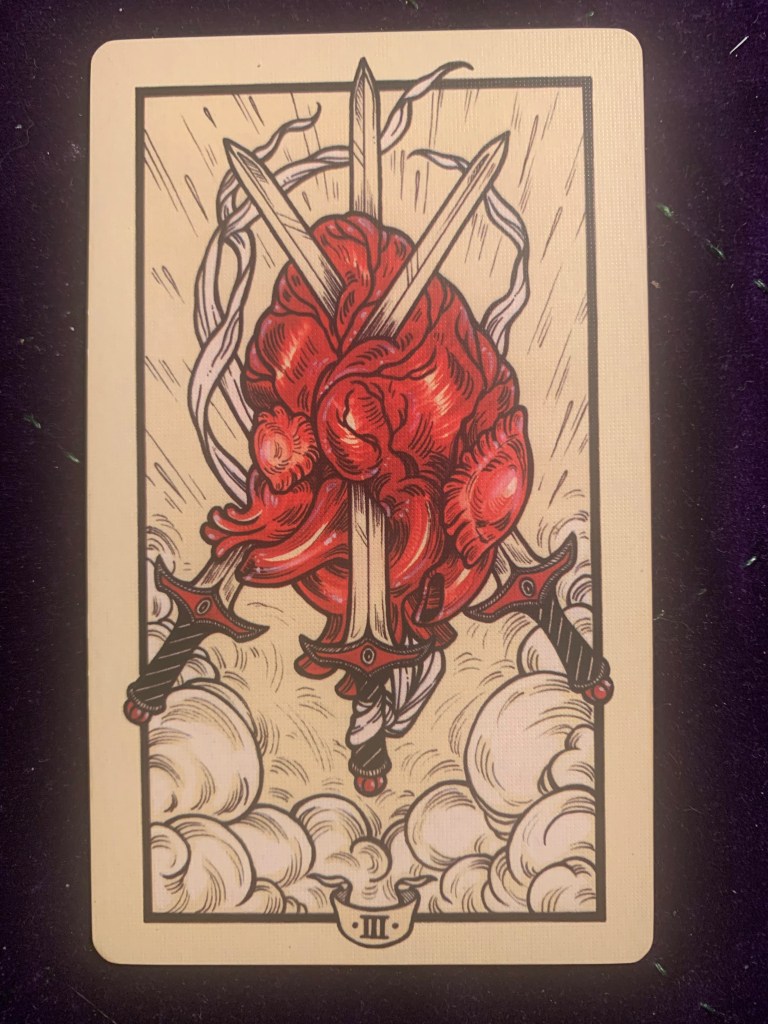
One of the most iconic images in the tarot, the Three of Swords displays a floating heart that is pierced by three swords. Above it, there are heavy clouds. There is also a heavy downpour in the background. The symbolism is pretty opaque, and the emotional effect that it has is immediate. The heart is the seat of warmth, affection and spirit, and the three swords indicate the power to harm, cause pain, and create suffering to what it pierces. This is an image of grief, loss and literally heartbreak. The clouds and rain depict the surrounding grimness of the situation. All these symbols point to the Three of Swords showing a low point in one’s life. source: Labyrinthos
From the Fyodor Pavlov Tarot
Gina Chick, a rewilding facilitator, was the first woman to win Alone Australia, the survival show in which contestants compete for a big cash prize after being dropped in remote wilderness to survive (alone) for as long as they can.
While her journey in the wild was inspiring it was her vunerability, her willingness to share her dance with traumatic loss and grief and the loss of her infant daughter to cancer which captured the imagination of Australians.
Processing Loss and Grief
Let us be clear! There is no set way of processing loss and grief and there are no timelines that one can observe. The ideas presented here are just ideas, processes that have helped some, but not all.
Use a spread to open a fresh window of perspective.
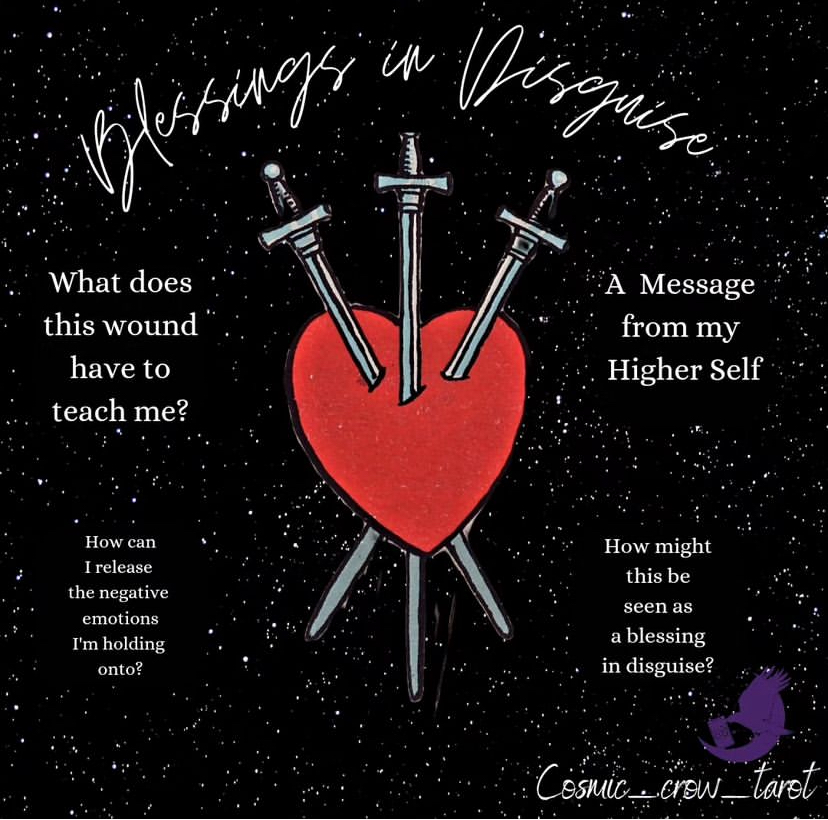
If you are a devotee of Tarot and Oracle cards you can lay down the Three of Swords in the centre and pull four cards. There is no magic involved. It is a simple reality that when you look at the images in the cards nuances and points of reference may rise up that help clarify the matter.
Make a Battle/Scar Cloak
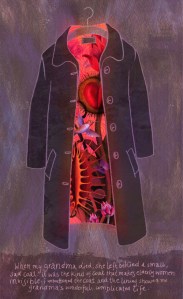
In her book Women Who Run With The Wolves in Chapter 13, Clarissa Pinkola Estes writes about Battle Scars and describes a process she uses in workshops. She shows women how to make a full length scapecoat from cloth or other material. This coat details in painting and writing and with all manner of things pinned and stitched to it, all the name calling a woman has endured, all the slurs, all the traumas, all the wounds, all the scars.
Of course this coat may become so heavy that you need a chorus of Muses to carry and sing over it but I think you get the idea! It helps heal!
The Five of Swords Tarot card comes with a warning as it can signify hostility, aggression, intimidation and violence and as such it can represent situations we would hope to never encounter in our lives such as crime, theft, bullying, abuse, assault, rape, murder.
Juanita Nielsen, a member of a prominent Sydney family, was a passionate activist and journalist. She lived in a terrace house in Victoria Street, Kings Cross, Sydney, and her father bought her a local newspaper called ‘Now’ which she published from her home.
There are some battles which put our lives at stake and taking on F.W. Theeman was one of them. Juanita conducted a vigorous editorial campaign in support of the ‘green ban’ movement against the redevelopment of Victoria Street by Theeman’s real-estate company, Victoria Point Pty Ltd. With her neighbour and trade-union activist Jack (‘Mick’) Fowler, she played a prominent role in mobilising residents against the demolition of Victoria Street’s historic terraces and the eviction of their tenants.
On 4 July 1975 after visiting the Carousel (previously Les Girls)—a transvestite nightclub and underworld haunt at Kings Cross—on advertising business vanished and was never seen again. During initial investigations, police uncovered information relating to a conspiracy to kidnap Ms Nielsen on Monday 30 June 1975 – four days prior to her last known sighting.
The “Five of Swords” in Tarot typically represents conflict, defeat, and betrayal. It can indicate a situation where someone has come out on top at the expense of others, often through manipulation or deceit. This card encourages reflection on whether the victory is worth the cost and advises against seeking success at the expense of others.
Attempts to find her or her corpse have proved fruitless and no one was ever charged with her murder. Despite public outcry, the mystery remains a major case in the annals of unsolved Australian crimes and has been the subject of podcasts and television programs. There is a significant reward for information that will finally provide some closure, especially for extended family.
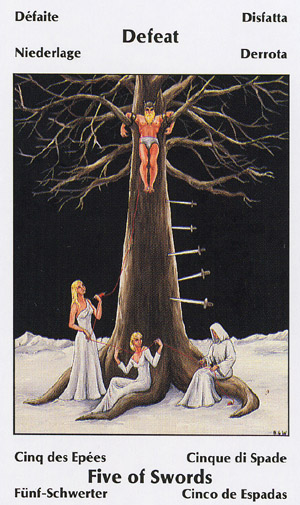
The Five of Swords represents a conflict or tension between individuals, which, if not resolved, will be a no-win scenario for everyone involved. This card symbolizes loss, betrayal, weakness, and the realization of limitations, which often stems from the desire always to come first, which is the root cause of the conflict, to begin with.
Much of Victoria Street was saved, but Juanita paid the ultimate price. She is remembered as a fierce advocate of community values and fighter against corruption. Her small terrace house at 202 Victoria Street is now heritage listed.
The message is loud and clear. When the Eight of Wands appears in a tarot reading, it provides a cosmic signal from the universe that everything is about to get moving and FAST! After years lying in a barn in obscurity word of Clarice Beckett’s outstanding art work is gaining momentum and a life of its own.
The Eight of Wands tarot card holds a powerful message of swift action, rapid progression, and forward momentum. It urges us to seize opportunities and anticipate swift outcomes. Like rockets soaring through the sky, our desires are quickly moving from the realm of imagination to the realm of tangible existence.
Clarice Beckett was born in 1887 in Casterton in regional Victoria. Today she is recognised as one of Australia’s most important painters of the interwar period, yet her contribution was almost completely lost to art history. Many of Beckett’s paintings were either destroyed or damaged after her premature death in 1935 from pneumonia which she contracted while painting in the rain near her seaside home at Beaumaris, Melbourne.
“To give a sincere and truthful representation of a portion of the beauty of Nature, and to show the charm of light and shade, which I try to give forth in correct tones so as to give as nearly as possible an exact illusion of reality
Clarice Beckett, 1923
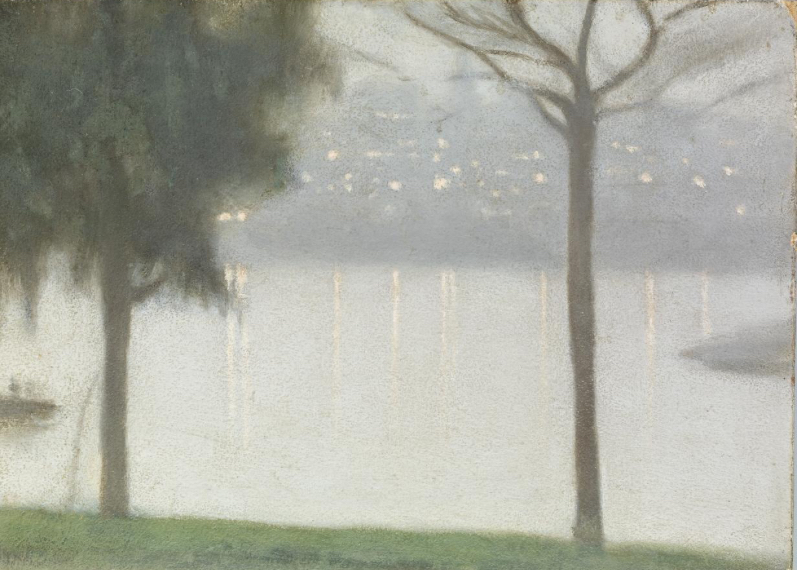
Beckett depicted everyday views of her local environment including transient subjects such as moving cars, trams, lone figures, waves and shadows. Her misty paintings of modern Melbourne in the 1920s and 1930s captured the outdoors, including sea and beachscapes, and suburban street scenes, that often recorded the shifting effects of light– either in the quiet, early morning or in the stillness of the evening.
Her paintings of the local environment possess a sense of timelessness. No prior knowledge is required to appreciate Beckett’s paintings, anyone who has engaged with the outside world can relate to and experience a connection to these subtle and silent paintings of nature.
Australian artist Clarice Beckett received very little recognition during her lifetime and re-emerged from obscurity when thousands of her works were discovered in country Victoria. She is now considered one of Australia’s leading female artists of the early twentieth century.
The reputation of this modernist painter has been successfully revived thanks largely to the lifelong work of art historian Dr Rosalind Hollindrake. But a biographer’s work is never done. Now aged 86 and the only person to interview those who knew Beckett, Rosalind is still uncovering things about the elusive, brilliant artist, lauded as the greatest female Australian artist we ever knew.
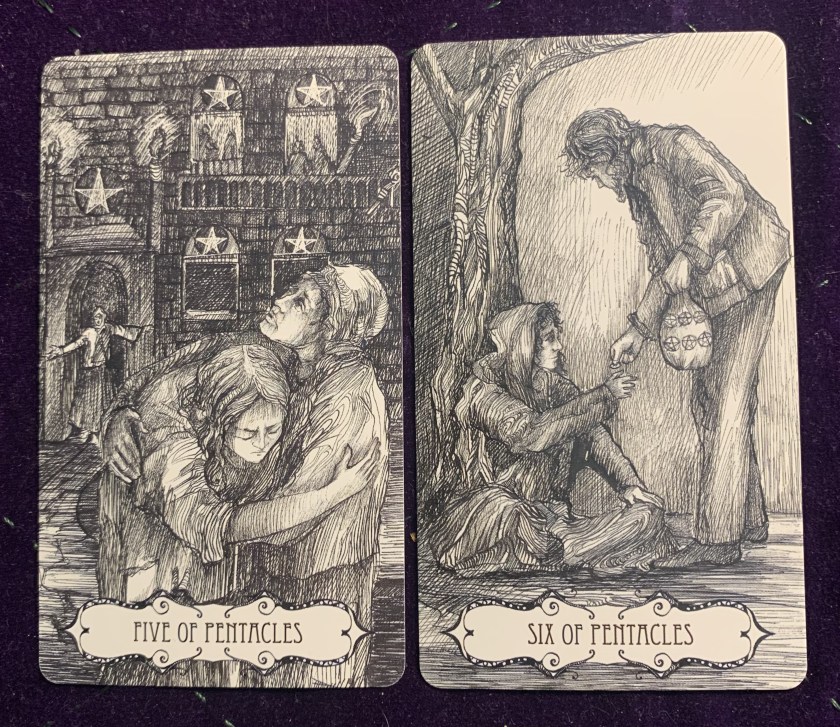
generosity, charity, community, material help, support, sharing, giving and receiving, gratitude
From The Tarot of the Abyss
It is no news to those who love Tarot that the cards can help us talk about the good, the bad and the ugly things that we all face on this planet. These images can help us to find the words to describe how we are feeling and they also have the capacity to draw out long buried memories.
The Five and Six of Pentacles can describe the almost cliche rags to riches story and equally can help us celebrate triumph in the face of adversity.
Ruby Hunter (1955-2010), singer/songwriter, was a Ngarrindjeri/ Kukatha/ Pitjantjatjara woman from South Australia. At the age of eight she and her four siblings and herself were taken from their family. She was placed in the Seaforth Children’s Home. Ruby remembered that the Government Authorities simply arrived one day in a big car, promising their grandmother that they were taking the children to the circus. At the time they were living with their grandmother on the Coorong at Meningie.
Ruby believed that the achievement of which she was most proud was keeping her family – Roach, their two children and three foster children – together as a stable unit.
While homeless Ruby met Archie Roach, also a member of the Stolen Generations, who had drifted to Adelaide from Mildura across the Victorian border. They met at a Salvation Army drop in centre as they were both living on the street. Forming a unique friendship during their time together on the streets of Adelaide, they formed an enduring bond that would last for the rest of Ruby’s life. They were inseparable partners.
During her life Ruby worked tirelessly to support and encourage young Aboriginal people, running an open house for teenagers. Ruby and Archie together cared for 14 children in a family house group home run by the Victorian Aboriginal Child Care Agency. Later they made their own home a welcoming haven for homeless and disadvantaged young people.
Ruby was also a strong advocate against domestic violence, and a voice for the stolen generations, and between them Ruby and Archie raised many foster children with their own two boys. Ruby believed that the achievement of which she was most proud was keeping her family – Roach, their two children and three foster children – together as a stable unit. She died of a heart attack at the age of 55.
Archie, unlike those who claimed work that had been written by their women, proudly tells the story of how his wife, Ruby, wrote Down City Streets.
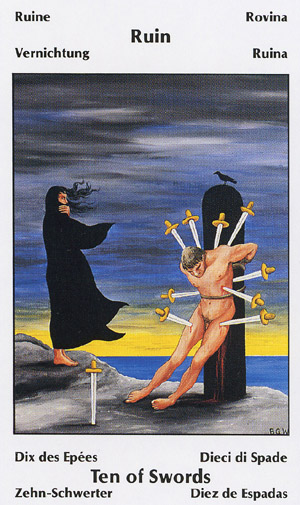
There is little positive to say about the five of swords, especially at this time in history as we witness the horrors in active war zones. There is even less that is positive if you lay Barbara Walker’s Five of Swords alongside the Ten of Swords. It’s about a battle in which there actually are no winners – by the time someone had triumphed, it was over anyway. There may ‘officially’ be winner and a loser… but from over here it doesn’t look like anyone is triumphant. And then there are the ongoing ripple effects of what has been done.
During their school years the majority of Australian students are not taught about the Indigenous massacres on Australian soil or are able to gain an understanding of what the stolen generation is all about. Even if they do watch ‘Rabbit Proof Fence’ or hear about these horrors. there are disturbing truths about the aftermath of all these actions that need to be acknowledged. It takes courage to look dispassionately at this stuff and understand the trails of trauma that have shaped so many lives.
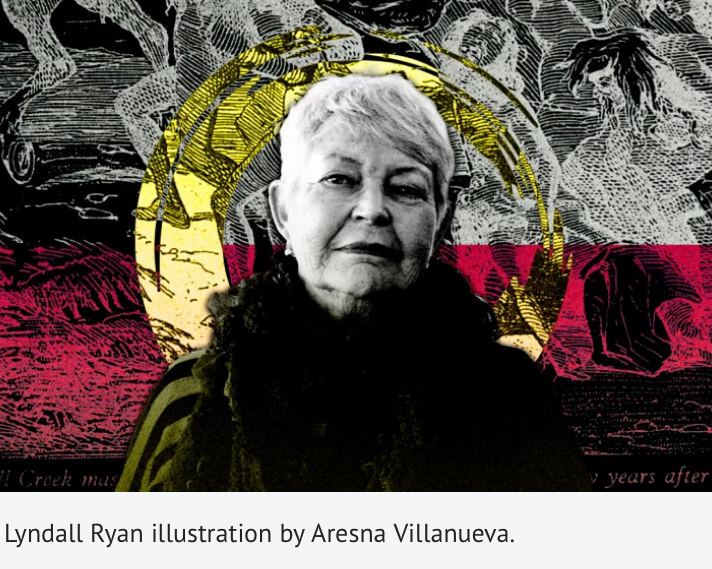
The daughter of Edna Minna Ryan (1904–1997) a committed feminist, communist and trade unionist, Emeritus Professor Lyndall Ryan believes that she was bestowed with a responsibility to present available facts and figures about indigenous massacres in Australia. It is her wish to present material in such a way that helps people understand and come to terms with the events of the past.
For the past eight years this 79-year-old and her research team have upheld an unwavering commitment to uncover and confirm the truth about Australia’s early colonial history.
It’s been an endeavour that has unearthed confronting and deeply disturbing details of the colonial frontier massacres of Aboriginal and Torres Strait Islander people.
The image of the 5 of Swords is usually depicted with a person who has captured the swords of his adversaries who are leaving, rejected and lost. There are storm clouds in the background. This card shows that you might be the conqueror or the conquered. But neither position has actually won. This battle was pointless, it was unfair and it was full of cowardliness. Basically, this is not one of the higher points of life.
The research project’s fourth and final stage’s recently released findings now estimate more than 10,000 Aboriginal and Torres Strait Islander people’s lives were lost during at least 414 massacres committed during the period 1788 to 1930.
Evidence also shows around half the frontier massacres were carried out by colonial officials, such as police and soldiers, either solely, or in conjunction with settlers and/or their employees.
And unexpectedly, the attacks during the spread of pastoral settlement in Australia did not decrease as the decades passed; they intensified. More massacres occurred in the period 1860 to 1930 than in the earlier period of 1788 to 1860.
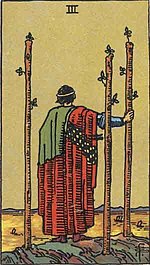
The Three of Wands holds the power to propel us forward, after a bad experience, on our journey towards growth and expansion.
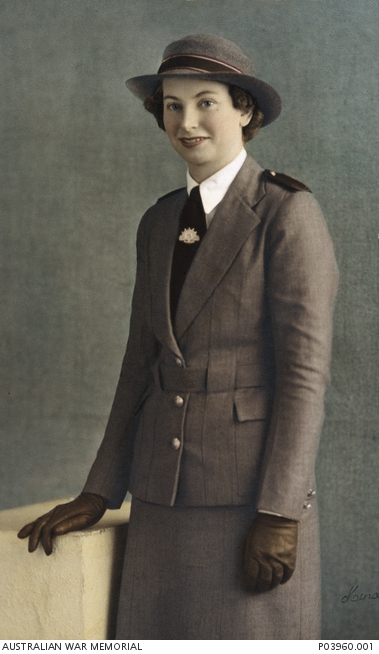
Vivian Bullwinkel, sole survivor of the 1942 Banka Island massacre, was born on 18 December 1915 at Kapunda, South Australia. She trained as a nurse and midwife at Broken Hill, New South Wales, and began her nursing career in Hamilton, Victoria, before moving to the Jessie McPherson Hospital in Melbourne in 1940.
Bullwinkles story is one of Australia’s most well-known stories of World War 2. She became known as a symbol of strength for nursing. Aside from her survival at Banka Island she and her companions, who were prisoners of war during World War II, refused the position of victim and went on to contribute much to the world after their ordeal.
The Three of Wands may signal the possibility for a major expansion. Whether this be in a new direction or taking over the world, you can begin plotting your next move. Don’t be thinking small – this card encourages big, epic visions. The Three of Wands also can suggest an opportunity on the horizon. That ship you were waiting on is in view.
When Vivian Bullwinkel returned home she devoted the decades after the war to nursing and honouring those who did not survive Bangka Island. She and fellow POW survivor Betty Jeffrey raised funds for a memorial. The Nurses Memorial Centre, a ‘living memorial’ to Australian nurses who had died in war, opened in Melbourne in 1949. Betty was its first administrator.
Vivian rose to become Matron of the Queen’s Memorial Infectious Diseases Hospital, in Melbourne, served on the Council of the Australian War Memorial and as president of the Australian College of Nursing. Honours earned include the Florence Nightingale Medal, an MBE and the AM.
Bullwinkle embodied important elements of resilience and it is our duty to convey to future generations so that they may be inspired to rise above adversity, foster connection with like-minded others, use adaptive coping mechanisms and soft power, be gentle yet persistent in their resistance practices, and most of all to do good work throughout their lives.
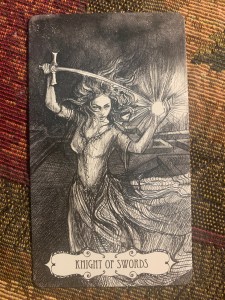
The Knight of Swords in tarot represents a person who is intelligent, quick-witted, and decisive. They are often seen as being a bit of a maverick, the warrior, as they are not afraid to go against the grain or challenge the status quo. They are also very independent and resourceful, and they are always up for a new challenge.
Here are some of the key characteristics of the Knight of Swords as a person:
Intelligence: The Knight of Swords is a very intelligent person. They have a quick mind and they are able to see the big picture. They are also very good at problem-solving and they are always coming up with new ideas.
Decisiveness: The Knight of Swords is a very decisive person. They are not afraid to make decisions, even if they are difficult ones. They are also very good at following through on their decisions.
Independence: The Knight of Swords is a very independent person. They do not like to be told what to do, and they prefer to forge their own path. They are also very resourceful and they are able to find solutions to problems on their own.
Adventurous: The Knight of Swords is an adventurous person. They are always up for a new challenge and they are not afraid to take risks. They are also very curious and they are always learning new things
The Knight of Swords might manifest in a person’s life as lawyer who is passionate about justice, a journalist who is always digging for the truth, an entrepreneur who is always starting new businesses, a soldier who is brave and courageous or a scientist asking question.
Journalist Dorothy Drain was born in Mount Morgan, Queensland, in 1909. A pioneer journalist in her field who wrote from the heart. Dorothy travelled overseas and saw first-hand the devastation of war in places like Hiroshima. She reported from Japan, Malaya, Korea and Vietnam and is remembered as one of Australia’s most outstanding journalists who helped pave the way for the Australian women journalists, editors, and war correspondents of today.
Dorothy Drain was certainly someone to shake things up a little, make a controversial statement or speak an important and genuine truth.
Alternative Perspectives – Who Would You Choose?
The Knight of Swords tarot card denotes a communicative, strong-minded, and at times opinionated person who is very action-oriented and thrives on change.
Given that there are literally thousands of artists identifying individuals to associate with a card this is a subjective process.
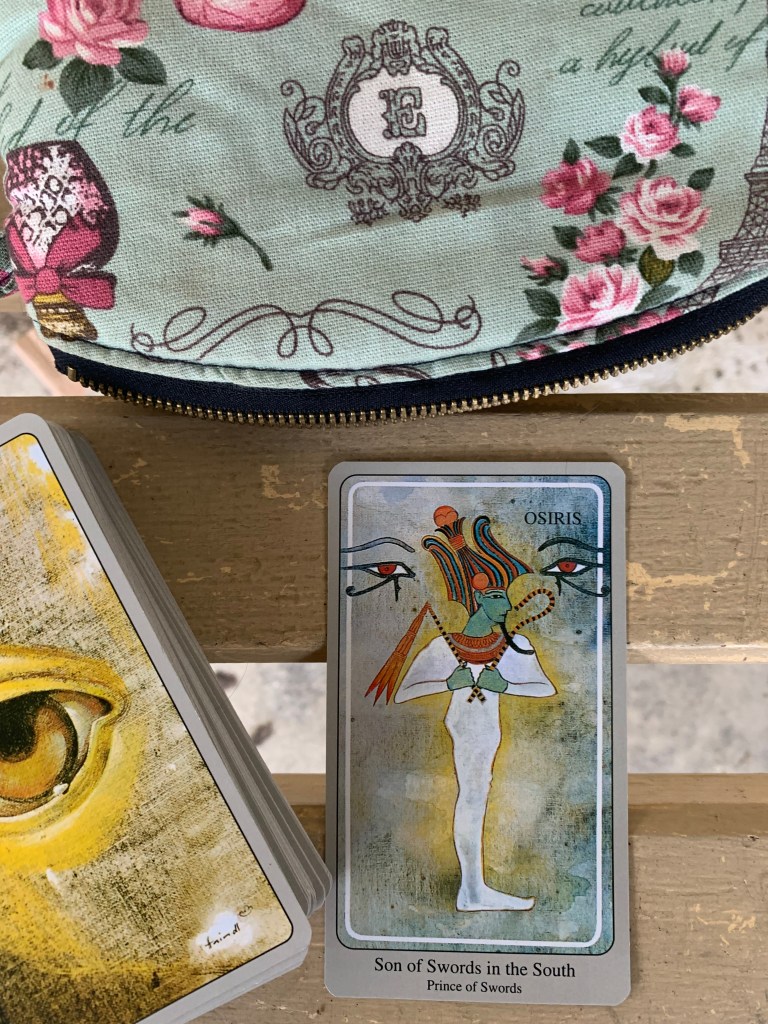
In the Haindl Tarot, Haindl presents Osiris as the Knight of Swords. Osiris was the god and chief judge of the underworld but he was also the god of vegetation. The annual Nile flood and was closely associated with death, resurrection and fertility. The ancient Egyptians believed him to be a dead king, a former ruler who had been miraculously restored to life after being murdered by his brother Seth. For this reason he came to symbolise the hope for eternal life that every Egyptian held.
Who springs to mind when you see the Knight of Swords? Perhaps write a portraiture or develop a character with Knight of Swords qualities.
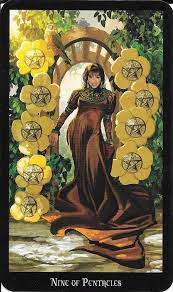
The Nine of Pentacles is a card of success and accomplishment. It represents the achievement of that kind of confidence and security that comes from having created something solid, something real, that you can now relax and enjoy. It’s a card of abundance and gratitude too. It represents feeling rich and strong in a really good way, having earned good things and appreciating them.
Known simply as ‘Sheila’, this foundation was launched in May 2019. ‘Sheila’ aims “to overturn decades of gender bias by writing Australian women artists back into our art history and ensuring equality for today’s women artists.” Sheila now supports female artists by purchasing and commissioning works; by providing scholarships for female art historians and curators; and by hosting an annual symposium on female Australian art.
This foundation exists because of the ground work of Lady Sheila Cruthers. The late Lady Sheila Cruthers was a passionate advocate for female artists. Leaving school at 14, Sheila had dreams of being a lawyer. She never got the chance, becoming instead a wife and mother. But this ambition, says Cruthers, channeled itself in other ways. In the 1970s she started to collect female Australian artists, dating from the contemporary back to the 1880s. (Just over 18% of the collection is Aboriginal.)
In 2007, the Cruthers Collection of Women’s Art – the country’s largest collection of its kind – was gifted to the University of Western Australia. Now housed at the Lawrence Wilson Art Gallery in Perth, her collection numbers over 700 works and is the largest, and the only stand-alone, collection of its kind in the country.
A rich inventory of monstrous figures exists throughout Aboriginal Australia. The specific form that their wickedness takes depends to a considerable extent on their location.
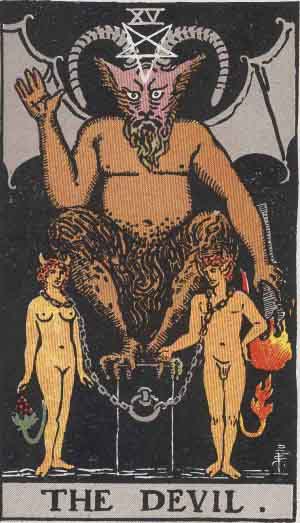
The Devil, with its foreboding images of demons and chains and some dark, scary hellscape points to the devil we all carry within us.
In the most literal sense many Indigenous people were chained.
As a student Catherine Bishop says she naively thought she had uncovered a feminist heroine when she discovered material about Australian missionary, Annie Lock. However, once she researched more carefully she found a woman of deep contradictions and was quickly disabused of any notion of the woman being a heroine: for all of Lock’s intrepid and gutsy behaviour, she held intensely socially conservative views in line with her religious conviction. The legacy of work done by her and other missionaries reverberates to this day and for first nations people may well be perceived to be the work of the devil.
In the Australian Central and Western Deserts there are roaming Ogres, Bogeymen and Bogey women, Cannibal Babies, Giant Baby-Guzzlers, Sorcerers, and spinifex and feather-slippered Spirit Beings able to dispatch victims with a single fatal garrote.
An interpretive drawing of Annie Lock by Heather Blakey October 2022
The places where Annie Lock was the ‘big boss to the natives’ were created and designed to ‘protect’ First Australians in a very patronising, paternalistic sense. Mainstream Australian thinking at the time was that Australia’s First Peoples were a ‘dying race’. Protectionist policies were developed reflecting this view. The interesting thing about Lock is that she didn’t adhere to all these view and her view that white Australians had taken Aboriginal land and owed them compensation was ahead of her time.
Born in 1876 into a Methodist sharefarming family of 14 children in South Australia’s Gilbert Valley, Lock was a practical woman with a very basic education. A dressmaker by trade, in 1903 she joined what would become the United Aborigines Mission.
It operated on faith lines: missionaries were unpaid and could not actively solicit donations, relying on prayer to answer all needs. Lock, like her colleagues, developed a nice line in inviting supporters to “join her in prayer” for very specific needs, such as “a nice staunch horse for £12”, hoping for a “practical” show of sympathy.
Follow the links and judge for yourself. Lock was a very contradictory, controversial figure. However, “while one may not admire all of Annie Lock’s actions or opinions, one cannot help but have respect for her courage, perseverance and the fact that she offered a friendly hand, albeit with strings attached. She was a significant figure in Australian history, one of an army of female missionaries who had profound effects, both positive and negative, on generations of Indigenous people. Lest we forget”.
Irene Torres, the Spanish artisan responsible for the Swiss Marseille Tarot and other Playing Cards, is currently the only female restorer of old decks of cards who redraws the images, creates the missing ones and fills them with vibrant colors, giving them a new life.
I was delighted when she accepted my invitation to, not only provide insight into how she works, but to talk about the Tarot card which best describes her as an artisan. Learn about how the Queen of Wands defines and informs her work.
“Like the Queen of Wands, I am a visionary who doesn’t follow paths already laid out by other people, since my skeptical and inquisitive nature prevents me from taking everything as good, without first passing it through my own filters. I love approaching tarot in my own way, because there are already other people who can do the same thing as always. That’s why I choose such special tarot decks or card decks to restore. Therefore, when I create a deck, the result is something totally personal and intimate, where I put part of my own essence, of my own being”.
The World represents self-actualisation and becoming. Becoming whole. Realising our wholeness, our completeness. Realising that we are one with the Universe, and really knowing that on a deep level, in our bones, in our minds, in our hearts, and in our souls.
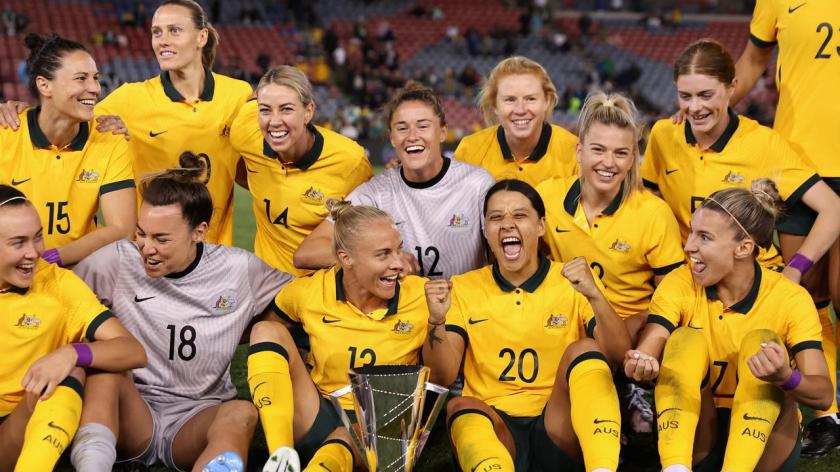
Historically, women’s sport in Australia has received far from equal representation in the media, with men’s sport spread across newspapers and permanently featured in primetime TV slots. However, this has been flipped on its head in 2023 as the Matildas smashed TV ratings and records during the FIFA Women’s World Cup, surpassing both the AFL Grand Final and State of Origin. They have, quite literally, turbo charged girls football in Australia
The Matildas’ Women’s World Cup semi-final match against England made history by becoming the most-watched TV program since the current audience measurement system ‘OzTAM’ launched in 2001. The Matildas’ clash with England attracted a national average audience of 7.13 million viewers, with Seven West Mediaannouncing that the Matildas’ semi-final match had smashed the record for the most streamed event ever in Australia.
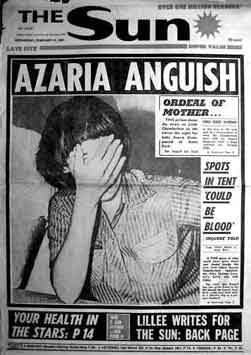
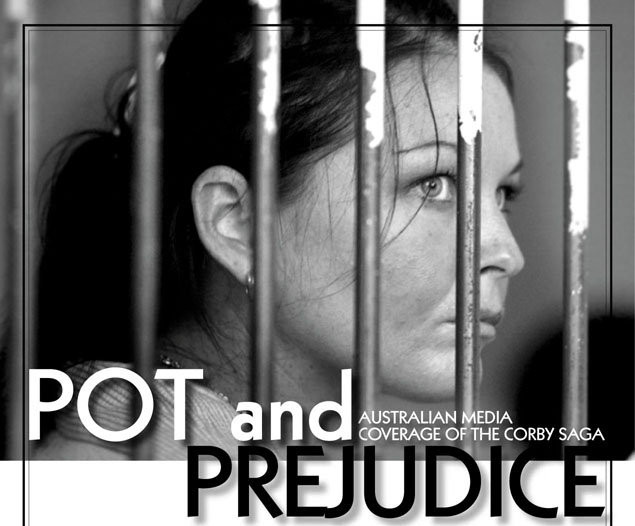
THE notion of Trial by Media is best understood as a situation where the media not only report the evidence presented inside a courtroom, but actually shape that news with very particular sets of opinion. In its most basic form, this is a ‘process in which mainstream media organizations ‘pick sides’ and act as de facto prosecutors or defence advocates before taking on the role of judge and/or jury.
When Trial by Media occurs in instances like the reporting regarding Lindy Chamberlain and Schapelle Corby the subsequent reporting firmly sets an agenda for many media consumers, who somehow end up feeling that they are now qualified to be members of the jury. The media and readers seem to feel that they have all the relevant information at their disposal and are able to sit in judgement. They have been positioned by these media reports as legal experts, and are encouraged by talkback radio and media-sponsored opinion polls to judge the merits of the case. In many instances, they go further by openly criticizing the performances of those acting in a professional capacity inside the courtroom.
The Judgement card is a call to face yourself, completely. To hold up a mirror to your entire life, to see it all. To own it all. Your successes and your failures. The good times and the bad. Everything you’re proud of, and all that you wish you’d done differently. It’s yours – and you must own it all, you must accept it all.
It is stunning to consider the tonnes of newsprint and hours and hours of broadcasting material devoted to Schapelle Corby’s arrest in October 2004, and her subsequent trial and conviction in May 2005. Three television networks (Seven, Nine and Pay TV’s SkyNews) telecast the verdict live in a three-hour satellite special. This was broadcast during a non-peak viewing period (Friday afternoon), yet still managed to draw over a million Australian viewers. In the first few weeks following the verdict, there were ongoing related stories about possible appeal processes, prisoner exchange schemes, differences of opinion between those advocating Corby’s innocence, and, of course, the alleged related incident at the Indonesian Embassy in Canberra, where some mysterious white powder was posted to officials.
Don’t pass judgment. If you find yourself being judgmental, stop yourself. This takes a greater awareness than we usually have, so the first step (and an important one) is to observe your thoughts for a few days, trying to notice when you’re being judgmental. This can be a difficult step. Remind yourself to observe.
Once you’re more aware, you can then stop yourself when you feel yourself being judgmental. Then move to the next step.
Understand. Instead of judging someone for what he’s done or how he looks, try instead to understand the person. Put yourself in their shoes. Try to imagine their background. If possible, talk to them. Find out their backstory. Everyone has one. If not, try to imagine the circumstances that might have led to the person acting or looking like they do.
Accept. Once you begin to understand, or at least think you kind of understand, try to accept. Accept that person for who he is, without trying to change him. Accept that he will act the way he does, without wanting him to change. The world is what it is, and as much as you try, you can only change a little bit of it. It will continue to be as it is long after you’re gone. Accept that, because otherwise, you’re in for a world of frustration.
Judgement as an Awakening
The word judgement usually implies that one is going to evaluate evidence before making a decision. However in the case of Tarot the Judgement card is often said to signal a time of resurrection and awakening, a time when a period of our life comes to an absolute end one must make way for a new dynamic beginning.
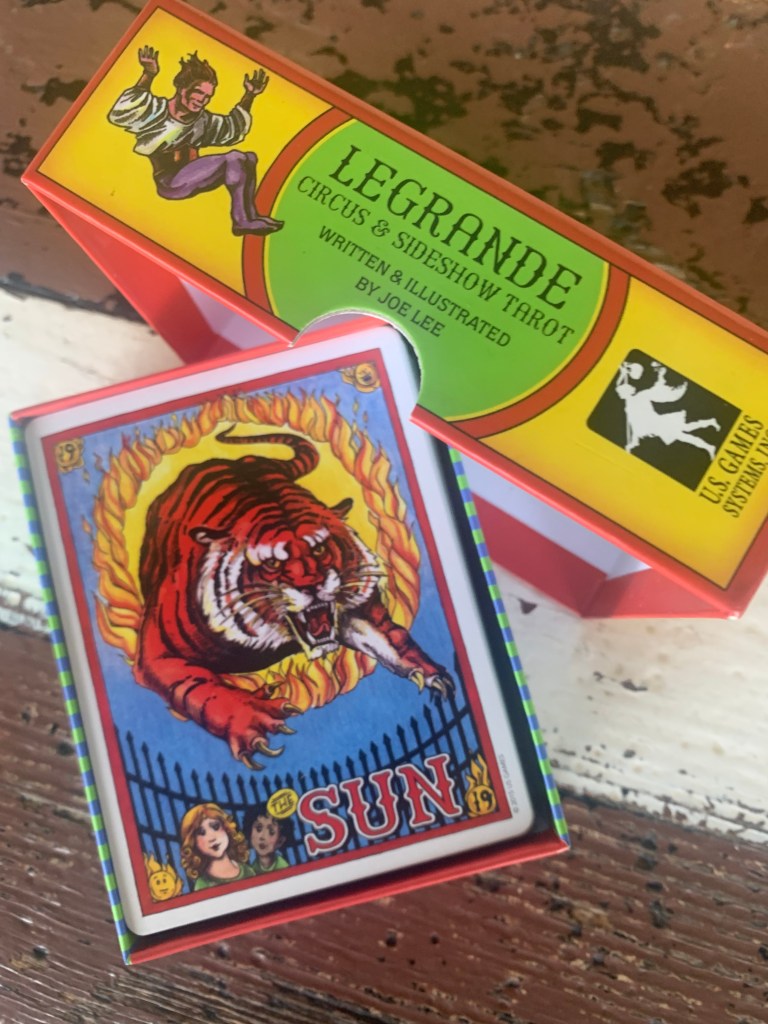
The Sun tarot card is a beacon of positivity and triumph, symbolizing abundance, joy, and unwavering faith in the universe’s love and guidance. As a major arcana card, the Sun signifies reaching a place of true clarity, illumination, and satisfaction after overcoming obstacles. When the Sun card appears in a tarot reading, it is a vibrant, energising sign of approval from the universe, promoting growth and encouraging you to follow your instincts and aspirations.
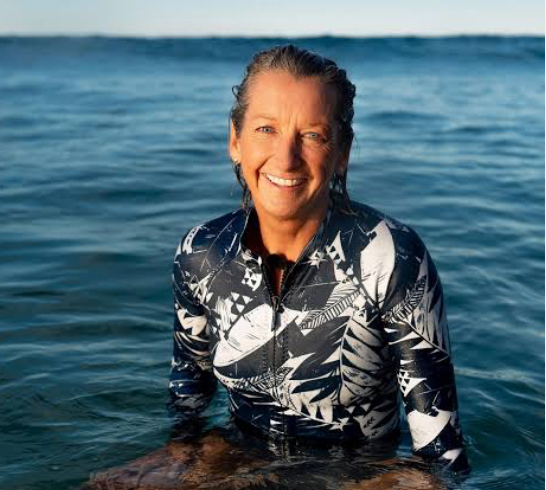
When the Sun tarot card appears upright in a reading, it generally signifies joy, accomplishment, and embracing one’s true potential. There is no question in anyone’s mind that Lane Beachley reached her full potential.
Layne Beachley is the most successful competitive Australian surfer of all time. Her list of achievements and accolades is impressive. Her dominance saw her win seven world championships, including a record six in a row, as she towered over the sport and inspired other young women to take to the waves.
It’s about success, good luck, things going your way. The Sun is a life-force that beams down and blesses all it touches with warmth. It encourages growth, it brings things to life. There is so much positive energy in this card, it is beaming with it.
The charismatic, cheerful, and uber-talented wave-riding champion from Dee Why was also the first surfer – male or female – to win six back-to-back world titles.
Beachley is often regarded as one the greatest female big wave riders in the sport’s history and was once considered the most influential woman in surfing.
Layne Beachley AO was inducted into the Sport Australia Hall of Fame in 2011 as an Athlete Member and was elevated to legend in 2023 for her contribution to the sport of surfing.
The Sun Card in Tarot Represents
The Sun reminds us to connect to life’s simple joys, the things that make us feel happier, lighter, freer, more connected. It’s about feeling grateful for the good things we have, realising the abundance in our lives, saying yes, and saying thank you on a deep level.
A time of harmonious relationships
Emotional growth
Enlightenment
Self-discovery
Fulfillment
Abundance
Success
Optimism
Confidence
Happiness
Joy
Contentment
This card encourages us to joyfully embrace our true selves and to be open to exciting new experiences.
As a figure stands beside overturned cups, the Five of Cups shows us a moment of pure sadness. What happened? It doesn’t really matter! This is a painful reminder of things that are gone and cannot be retrieved.
It is confronting, but do take the time to watch this interview with Marjorie Woodrow who was stolen from her parents when she was 2 years old. Like so many others like Marion Woodrow suffered abuse in many children’s homes. Read moreAbuse of Stolen Children – Creative Spirits
Sydney woman Valerie Linow became the first member of the stolen generations to win monetary compensation for her cruel treatment after authorities removed her from her family. When she was nine, she was taken to south-west New South Wales, to the Cootamundra domestic training home for Aboriginal girls. She left six years later and was forced to work in the town of Wombat for a former police officer, who raped her when she was 15.
The Star is a card of hope, I renewal, and quiet endurance. It appears after upheaval and reminds us that even in the shadow of great sorrow, light still exists. This card speaks of courage, faith, and the small acts of kindness that guide people through uncertain times. It asks you to trust that what is needed will arrive, and that hope itself can become a beacon for others.
Before thousands of Australian soldiers departed for the battlefields of World War I, many fixed their gaze upon a small, windswept island near Albany in Western Australia. There lived Fay-Catherine Howe, the teenage daughter of a lighthouse keeper.
Skilled in semaphore and Morse code, fifteen-year-old Fay became an unexpected lifeline between the departing troops and the families they were leaving behind. From the island she relayed messages to the soldiers using signal flags, then transmitted their replies back to Albany by telegraph and undersea cable, where they were delivered as telegrams to waiting loved ones.
Though she never truly knew the men she signalled to, Fay became a cherished symbol of home — a final human connection before the ships disappeared beyond the horizon. Her compassion and dedication left such an impression that many soldiers later sent postcards to her from the front.
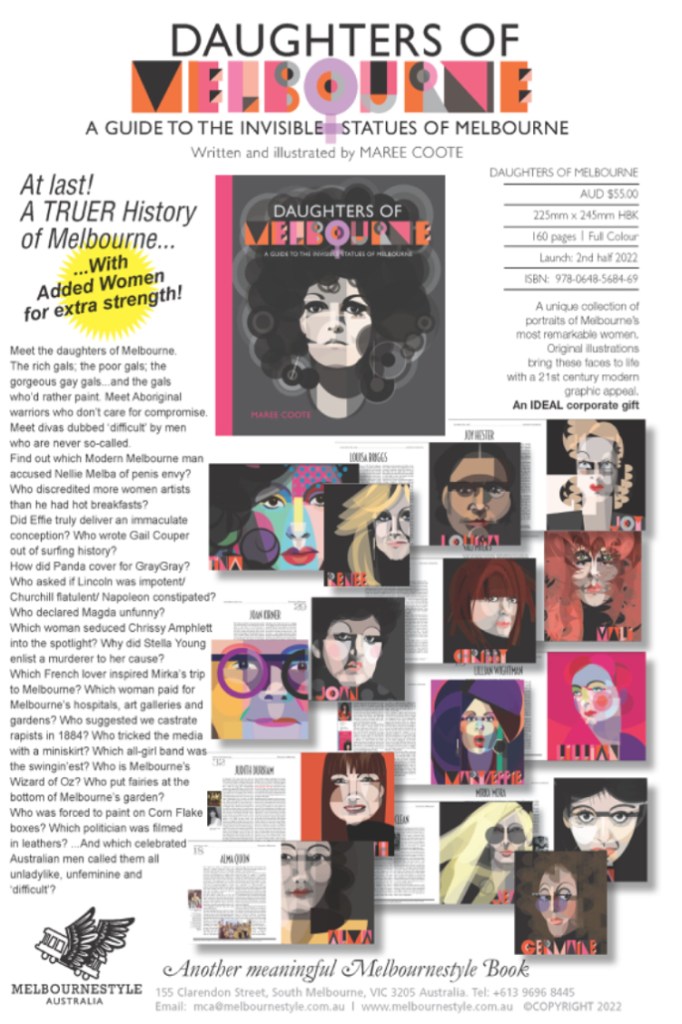
“There was a nude, a nymph, a mermaid, a nurse from Britain, a nun from Italy, Queen Victoria but no Melbourne women at all,” said Coote.
Meanwhile, “dead white men abounded, worthy and unworthy, local and foreign, on and off horseback”.
Rather than wait forever for the gatekeepers of culture to acknowledge women, she just decided that dammit, she’d just write a book and acknowledge them.
You do not have to be Australian or profile an Australian woman. You are simply provided with an opportunity to redress the Matilda Effect by bringing the women’s stories out of the shadows. If you decide to engage I will link and or feature your profiles on this site.
The Matilda effect is a bias against acknowledging the achievements of women scientists whose work is attributed to their male colleagues. This phenomenon was first described by suffragist and abolitionist Matilda Joslyn Gage in her essay, “Woman as Inventor”.
The image of the Tower card is powerful, depicting a solid tower being struck by lightning, and fire crawling out from the small windows at its top.
As Death shows us, change can be hard. With the Tower, it can be brutal. Rosie Batty has written about her heartbreak.
“The Tower – whatever it represents in your reading – comes crashing to the ground. All that you held to be true is suddenly…not true. The world looks different, and it can feel like a disaster. This card’s usual image of lightening destroying a tower is incredibly scary – destruction is all that we can see. The ground is unsteady beneath our feet. We don’t know what to hold on to.”
Quite rightly Batty still wonders “How on Earth, when you become one of these tragedies — these worse-case scenario tragedies — how do you live with murder?”
“If anything comes out of this, I want it to be a lesson to everybody that family violence happens to everybody no matter how nice your house is, no matter how intelligent you are. It happens to anyone and everyone.”The Batty Effect
Many tarot readers talk about their own ‘Tower moments’, referring to those huge and very challenging moments in our lives where everything shifted. Most recall the terror at the moment of fallout but also observe that when the dust has settled things do regain some balance. There is no doubt that Batty’s work to raise awareness about family violence since Luke’s death, gave her “new distractions, new purpose”. Whether she will ever get over what happened is debatable. However, the impact of her work has been far reaching and provides some comfort for her.
By January 2016, she had spoken at approximately 250 events and addressed more than 70,000 people. She had also inspired Victorian Premier Daniel Andrews to commit to an Australian-first Royal Commission into Family Violence. She has, quite literally, changed the conversation about domestic violence in Australia.
Rebuilding
When you are ready, the Tower is also about those steps you take to rebuild.
The Hanged Man tarot card symbolizes sacrifice, surrender, and letting go. It often appears in readings to indicate a time of pause, reflection, and reevaluation of one’s beliefs and priorities.
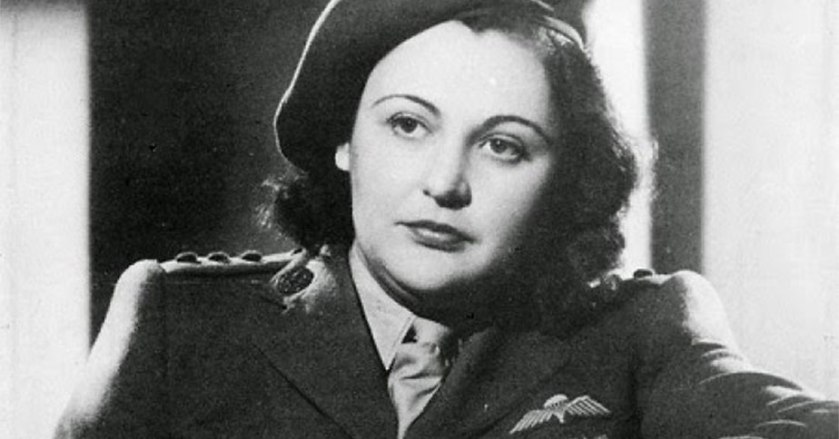
Nancy Grace Ausgusta Wake was born on 30 August 1912 in Wellington New Zealand. She was the youngest of six children and was raised in Australia. Shortly after moving them to Australia her journalist father deserted the family leaving them to face poverty and hardship. This event is believed to have sparked her rebellious nature and fearsome temper.
At 16 Wake used a £200 inheritance from an aunt to travel to London, where she studied journalism before moving to Paris. While travelling through France writing articles to support herself, Nancy met the man whom she later married. Henri Fiocca was a wealthy French industrialist living in Marseilles where the two settled prior to the war.
As a naive, young journalist, Nancy Wake had witnessed a horrific scene of Nazi violence in a Viennese street. In 1933 on one of her first assignments Wake was to interview Adolf Hitler in Vienna. It was at this point that Nancy Wake first came face-to-face with impending rise of the Nazi regime. From this point, she was committed to bringing down Hitler and his regime and she was true to her word. Among other things she helped build a highly successful escape network for Allied soldiers, perfectly camouflaged by her high-society life with Fiocca n Marseille.
The Hanged Man card is sometimes referred to as the traitor card. As history makes blatantly clear, persons whose individual conscience is in opposition or divergent from the collective viewpoint, can appear as traitors to the Establishment. Often upside down in relation to family, friends and the government, nonconformists can be even branded as criminals.
Though she was never caught, word spread throughout the German Gestapo of a mysterious dark-haired woman operating the southern escape. She became one of the Gestapo’s most wanted and with a five million franc bounty on her head she became known as ‘The White Mouse’ for her continued ability to evade capture. Her husband was not so fortunate and was tortured and executed when he would not reveal the whereabouts of his wife.
After the war she was decorated by Britain, France and the United States. She received the George Medal, 1939-45 Star, France and Germany Star, Defence Medal, British War Medal 1939-45, French Officer of the Legion of Honour, French Croix de Guerre with Star and two Palms, US Medal for Freedom with Palm and French Medaille de la Resistance for her courageous endeavours.
Unable to adapt to life in post-war Europe, she returned to Australia in January 1949 aged 37 and, not surprisingly, given all that she had done and witnessed, never really settled.
King Solomon of Israel captured and contained 72 rebellious demons within a brass vessel. He threw that vessel into a deep Babylonian lake in order to keep others from discovering the power it held. While searching for the treasured vessel, the Babylonian’s broke it, releasing the demons.
Given the sheer evil that exits in the world any attempts to thwart the Devil would seem to have been in vain. This reviled figure has managed to have an impact no matter the gender.
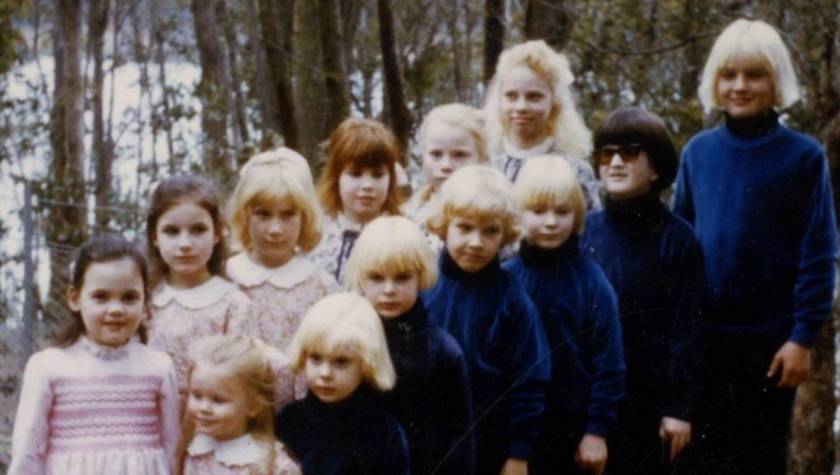
The subject of a True Life Podcast, Anne Hamilton-Byrne wore pearls and Chanel perfume. She played the harp and sang soprano. She had blonde hair, styled in waves that caught the light. As leader of The Family, the Australian doomsday cult she founded in the 1960s, she claimed to be Jesus reborn as a woman.
One of the few female cult leaders in history – and apparently one of the cruellest – Hamilton-Byrne operated in almost total secrecy over two decades. Hidden away in the countryside outside Melbourne, The Family’s motto was “Unseen, unknown, unheard”. The police, acting on information from two child escapees, raided the cult in 1987. It emerged that over the years Hamilton-Byrne had collected 28 children through bogus adoptions and “gifts” from followers, dressing them in identical clothes and bleaching their hair platinum. To keep her eerie brood under her control, they say she subjected them to vicious beatings, starvation and emotional torture.
The Hand of the Devil?
Satan, or the Devil, is one of the best-known characters in the Western traditions of Judaism, Christianity, and Islam. Surprisingly, this entity was a late-comer in the ancient world. Satan, as a totally evil being, is nowhere to be found in the Jewish Bible. He evolved during the height of the Persian Achaemenid Empire (beginning c. 550 BCE) and was adopted by Jews living under Persian rule at the time. His formal name, Satan, derives from the Hebrew ‘ha-Satan’. ‘Ha’ means ‘the’ and ‘Satan‘ means ‘opposer’ or ‘adversary’.
Death (XIII) is the 13th trump or Major Arcana card in most traditional Tarot decks. The Death card signals that one major phase in your life is ending, and a new one is going to start.
“For Life and Death are one, even as the river and the sea are one.” – Khalil Gibran
Helen Callanan is a death doula who established an organisation called Preparing the Way.A death doula is a companion, advocate and educator for the dying and their family through the process of death. They nurture and support the dying and their family in a practical and empathetic way with the ability to tailor their approach to each person’s needs.
Pragmatic Approaches to Death
Let’s get real! Denial does not protect any of us. No one gets off this planet alive and unless we head off first we inevitably face the deaths of those close to us. It makes complete sense to stop with the frightened stuff and be prepared. To be prepared is actually life affirming.
When my husband died in 2007, we didn’t use the traditional funeral parlour. It was news to me that you could have a funeral in the back yard or a park if you wanted to. Syd Peak and Daughter enabled us to have a ‘transformative’ funeral in the park opposite our home, of the kind that Natural Grace Funerals, Tender Funerals and Zenith Virago are now offering. Perhaps the most moving aspect of what we did at the time is that his biking community took his ashes, sewn into a toy bear, on the biking trip to Queensland that he had so wanted to do.
Making Descansos
If you don’t have a specific place to mark a death you can set up a website or pull out your art and craft supplies and create a collage.
In my experience it is the living, rather than the dead that need to find a way to RIP! After all, the dead are dead aren’t they? It is the living who have to manage to go on living!
All cultures have ways of dealing with and managing grief. I first learned about the concept of Descansos when I read Clarissa Pinkola Estes ‘Women Who Run With Wolves’. Estes describes how when you travel in Old Mexico, New Mexico, southern Colorado, Arizona, or parts of the South, you will see little white crosses by the roadside. These are descansos mark resting places and formally marking these resting places with crosses, memorabilia and flowers offers some solace to those left behind. The concept of marking resting places is not confined to the United States or Mexico. They may be found in Greece, Italy and many other countries, including Australia.
Over the years I have encouraged participants in my writing classes to address their losses by making Descansos in their journals or on a website. When I made a site after the death of my husband I was applying the concept of Descansos to mark the loss. Making Descansos is a wonderful way to honour all the big and little deaths, the endings, the transformative events that we have experienced.
Death Signalling the Need to Adapt
The Death card is the number 13 card of the Major Arcana. It’s astrologically associated with the sign of Scorpio, the sign representing “sex, death, and taxes.” Seeing the Death card in a reading is not a foreboding omen. It does not foretell the death of the person being read, or anyone else for that matter. Rather, it symbolizes the ending of a cycle and the transition into a new one.
Of course, faced with actual death we inevitably end one cycle and move into another. Unless we end one phase of our life, we cannot begin a new one. Children move out of home, we change jobs, relationships end, we move houses, states and countries.
The Northern Animal Tarot reminds us to look at nature and to learn from the cycles she goes through. Another option is to go online and learn about how different cultures deal with death and dying.
Pull out your journal and consider some of the following.
1. What things have changed in your life?
2. Faced with death, will you have any regrets about choices you have made?
3. In order to make the most out of life, is there something you feel you need to change?
4. Has something blocked you from making this change? What have you never done that you want to do before you die?
5. Is there something you need to walk away from now?
6. What are the barriers to making the changes you need in your life?
8. What makes you frightened of, or threatened by, change?
9. What will you lose if you make the changes that you want to make?
10. What support would help you to make these changes?
11. How do you see your life after making the changes that you need to make?
12. How can you help others to accept the changes that you have to make?
13. Is it time for you to put the old ways of thinking behind you; to finally free yourself from a past which no longer serves you?










 Waltzing With Matilda's